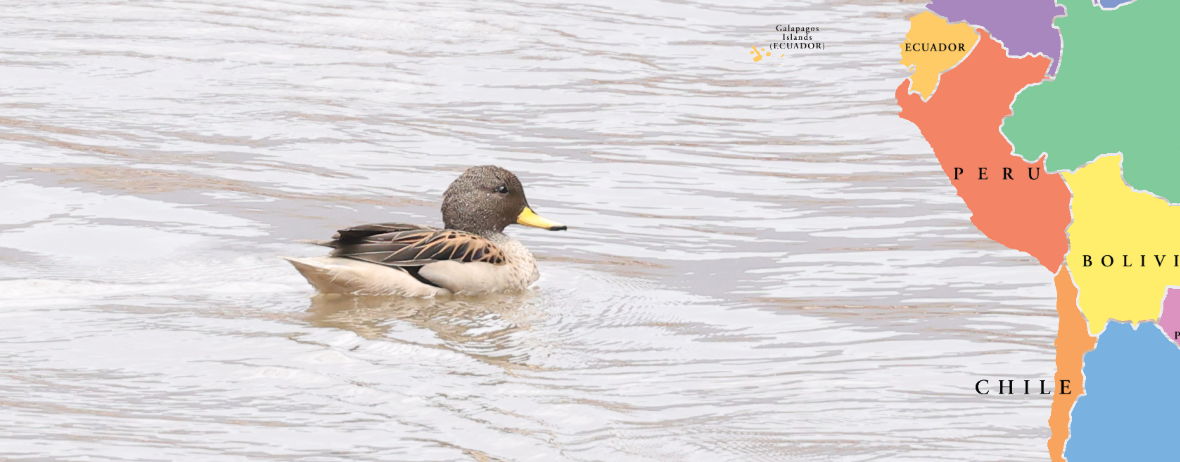
In which two of the Bird Spots crew undertake an epic four month birding and cultural tour of South America.
Goals of the Trip
Long-time followers of this website will know that our international birding adventures are usually accompanied by mostly breezy photo-driven summaries with cheeky captions. We’re changing tack now as we embark on some longer, more involved trips, aiming to be more helpful to certain types of birders who are looking for some deeper information and context about various potential birding places (more so now, regions) they might want to visit themselves.
To wit, the goals of our journeys are:
- To balance the joys and satisfactions of birding with exploring various cultural and tourist attractions that might be available;
- To practice “slow travel” – prioritising depth of experience and not rushing through trying to obsessively tick off as many bird species as possible (a practice that many professional birding tours typically cater to) – but instead staying in one place for a bit longer so as to understand and appreciate the local area;
- To identify ways to positively contribute to the environment – whether it be patronising various paid-for sites like hummingbird and tanager gardens, donating to worthy causes such those attempting to rejuvenate land for wildlife, or whatever else we can do to pursue eco-tourism.
The “slow travel” aspect might appeal to retirees and those looking to take things a bit easier, and are not travelling simply for birds, or who want to incorporate birding with broader travel pursuits, and who have time to spend in a more chilled-out manner when they travel. Hopefully, this blog post and subsequent posts covering some select regions and experiences in Peru, Ecuador and Chile will be helpful in that way.
The Birding Philosophy
It’s easy to get worked up by the endless social media posts of amazing birds (my Facebook feed is largely just bird photos and birding tour reports, which is mostly the way I like it!) And certainly there are some incredible places with vivid birds and wildlife that we can all appreciate through our phone screens. What’s often not told is the experience of being there – how accessible was the place? Lodgings and home comforts? How long to spend there, and how to approach it (e.g. best as part of a guided tour?) These are the more contextual aspects of birding and travel we’ve always tried to emphasise through our “bird spots” philosophy.
Take the famous Manu Rd in the Cusco region of Peru: the eBird hotspots, some with a staggering 770 species or more (over all time), might well make you salivate!
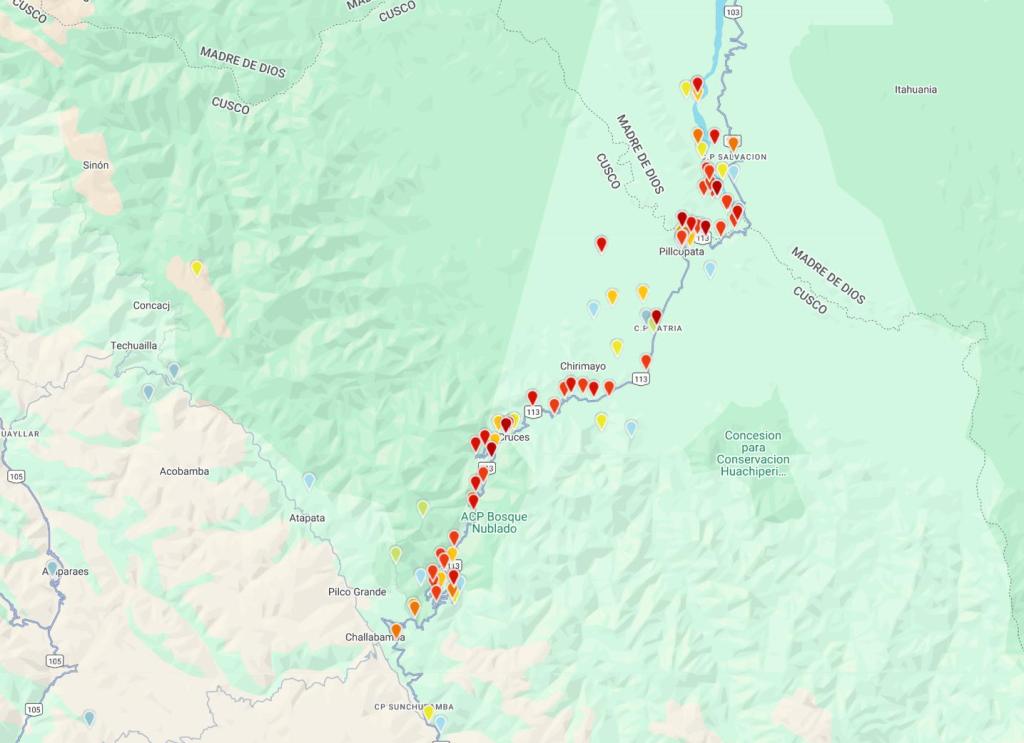
How to approach this: how do you get to this region? Where do you stay and for how long? What are the local conditions like, and are there times of year that work best? What non-birding activities might be interesting?
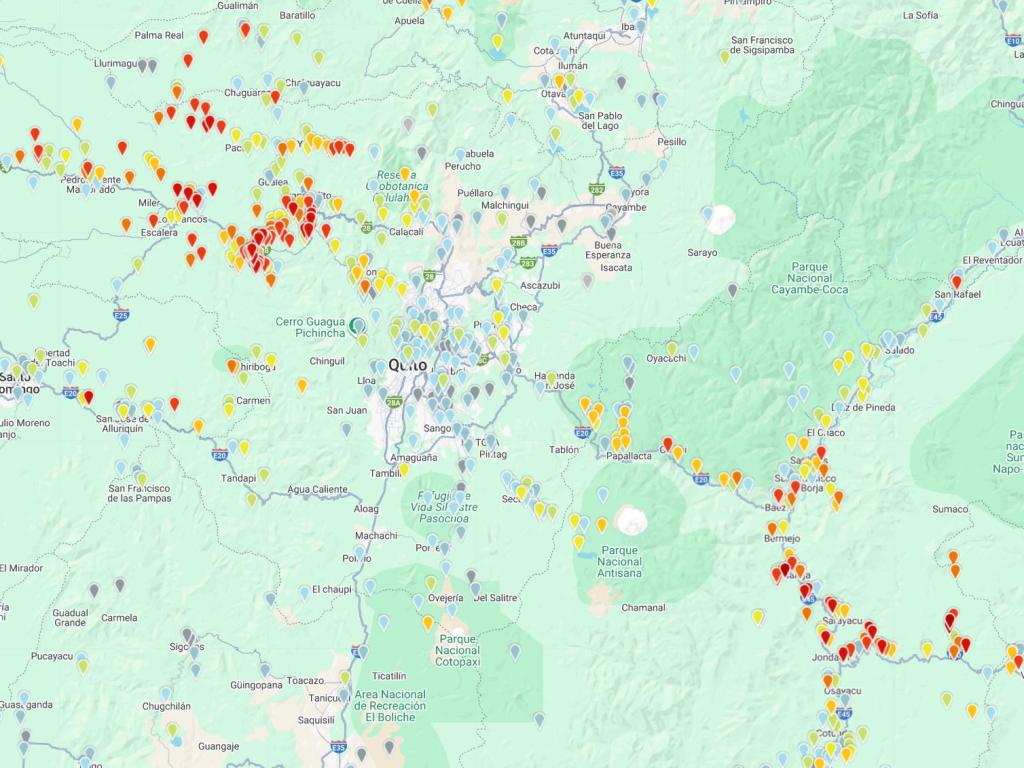
Like Peru, Ecuador is similarly blessed with incredible biodiversity, boasting over 1700 species in a relatively small country. Clusters of deep-red hotspots abound both on the east and west side of its capital city, Quito.
There are dozens of birding companies offering birding tours in both Peru and Ecuador; the choices can be overwhelming (just Google “Peru bird tour” or “Ecuador bird tour”). Because they usually include transport, lodgings and a guide, and charge per person, they can seem quite expensive. Typical tours run from a few days to a few weeks; many tours spend only long enough at a locality to find the endemics or difficult/desirable birds, then move onto the next site, so that the tour can involve long days and a lot of driving. More and more, however, operators are also offering “relaxed tour” options which are a bit slower, as well as photography-focused options which are less about ticking off the hardest birds.
Seasons and Elevations
A key part of researching when and how to travel in Peru and Ecuador especially from a birding perspective involves understanding the seasons, local climate, and altitude.
For Manu Rd in Peru, the dry season is May to October while the wet season from November to April can lead to impassable roads due to landslides and rockfalls. The upper part of Manu Rd is around 3000m in altitude and it drops to around 600m over the course of its 80km (this is part of the reason why it’s regarded as a great birding destination, as you can find birds that are specialised to different altitudes in close proximity). Manu Rd is most easily approached from the western side, which is all high Andes; we chose to fly into the city of Cusco (as it has a flight connection from Santiago in Chile) which lies at 3400m above sea level. You can definitely get altitude sickness symptoms flying straight into this elevation; one way to mitigate that is to acclimatise in a nearby town at a slightly lower altitude (we chose Pisac, at 2900m).
For the rest of our Peru trip, we included in our itinerary other well-known sites in the south-east of the country, like Lake Titicaca (also quite high at 3800m), Colca Canyon (around 3400m) and Arequipa (2300m). We looked at Iquito and the vast Amazon region in north-east Peru, but decided to leave that to another time (pending our tolerance for jungle heat, insects, etc etc).
Quito in Ecuador lies at around 2850m, still high enough to give altitude effects. Birding areas to the west and east drop off to lower elevations however. Quito has a similar dry/wet season dynamic to Manu Rd but that is a simplification – it is a bit more complex than that and it is more like Jun/Jul/Aug is genuinely dry and the rest of the year is pretty rainy.
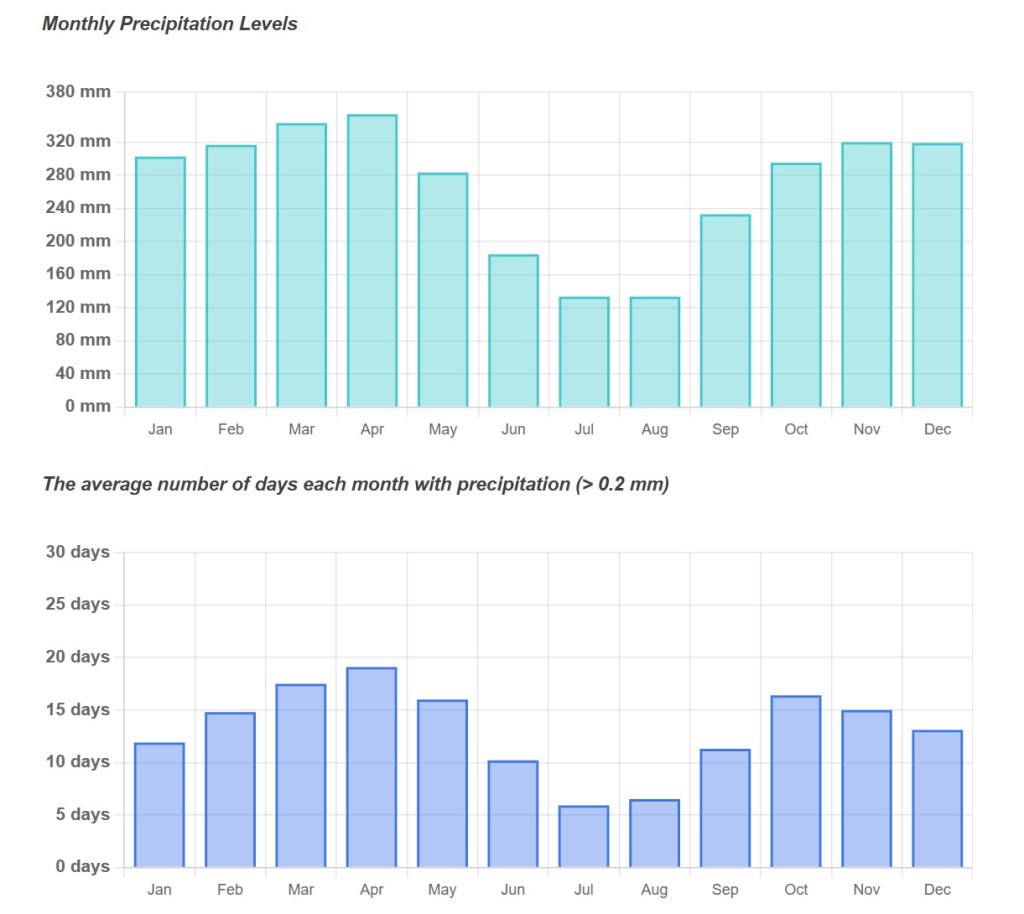
We didn’t have the luxury of traveling to Ecuador mid-year, but at least we know roughly what to expect in terms of rain.
In terms of temperatures, the altitude again makes a difference: the Cusco and larger Peruvian “altiplano” region can be surprisingly cool, despite being near the equator – temperatures range from 9 or 10 degrees to 23 or 24. Quito is even cooler, barely breaking 20 degrees during the day in November. Lima on the coast is milder with night-time temperatures around 17 and only 23 or so during the day, an effect of the nearby Humboldt Current mixed in with proximity to the Andes.
For southern Chile and Antarctica, of course, it’s going to be very to extremely cold, so we’ll need to pack some seriously warm gear.
Tourist and Cultural Attractions
So, it’s not all about birding! One of the great things about the Cusco region in Peru is that not only is there incredible birding at Manu Rd (and similar high-altitude birding hotspots at Abra Malaga, not too far away), but here you also have Peru’s most famous tourist attraction of Machu Picchu, as well as various Incan and pre-Incan historical sites in the broader Sacred Valley. You can undertake amazing birding journeys as well as soak in the history and culture all within a relatively small geographical area (and all rather easily reachable by flight into Cusco).
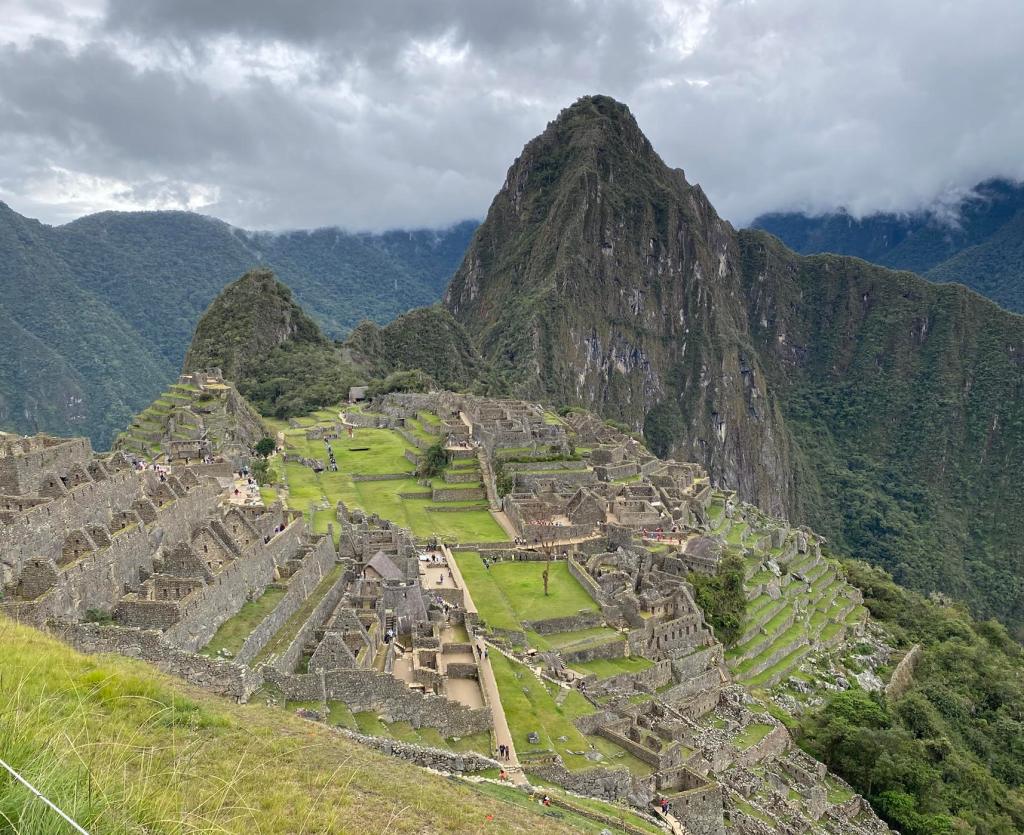
The Cusco region was a no-brainer, and within reach of that there is Lake Titicaca (to the south-east, nearer to the Bolivian border), which is the highest navigable lake in the world and seems to be a tourist drawcard (with the bonus that you can take a train there!), and not far away again, Colca Canyon, another tourist hotspot and home of the mighty Andean Condor.
Our research for Ecuador seemed to suggest that the country is now much less safe than it was a few years ago, when it had a reputation for being one of the safest South American countries to travel in. Nowadays it seems you have to be very careful especially in the bigger cities (including Quito) and anywhere near the country’s borders. Most of the attractions near Quito seem to be nature/forest based so we decided to concentrate on the birding lodges, stringing a few of these together (cherry-picking, really), and chaining on a jaunt out to the bucket-list Galapagos Islands as well (only reachable from Ecuador).
For those Ecuador lodges, there is something of a mixture in how they operate. Some lodges have an online reservation capability where you can just plug in your dates and book the accommodation, while other lodges can only be accessed as part of a tour package – you have to email them and they will put together a (likely customised) itinerary for you, usually trying to up-sell you a guide, airport transfers, etc. In one case (I won’t mention the lodge by name) I felt like I was being seriously overcharged for a proposed 5 day tour where they threw in a whole bunch of activities and didn’t address my concerns when I challenged, so I ditched their option. So beware!
Chile has a bit less bird diversity than Peru and Ecuador but nevertheless has some impressive landscapes (the Atacama desert; the Lake District with its volcano views), as well as having the iconic attractions of Patagonia and Antarctica in the extreme south.
Booking and Planning
Right, so we have a rough idea of what we ideally want to see, and our time frame from early October 2025 to about mid-February 2026. As noted, we decided to stick to the western countries of the continent – Brazil, Argentina etc can wait until another time!
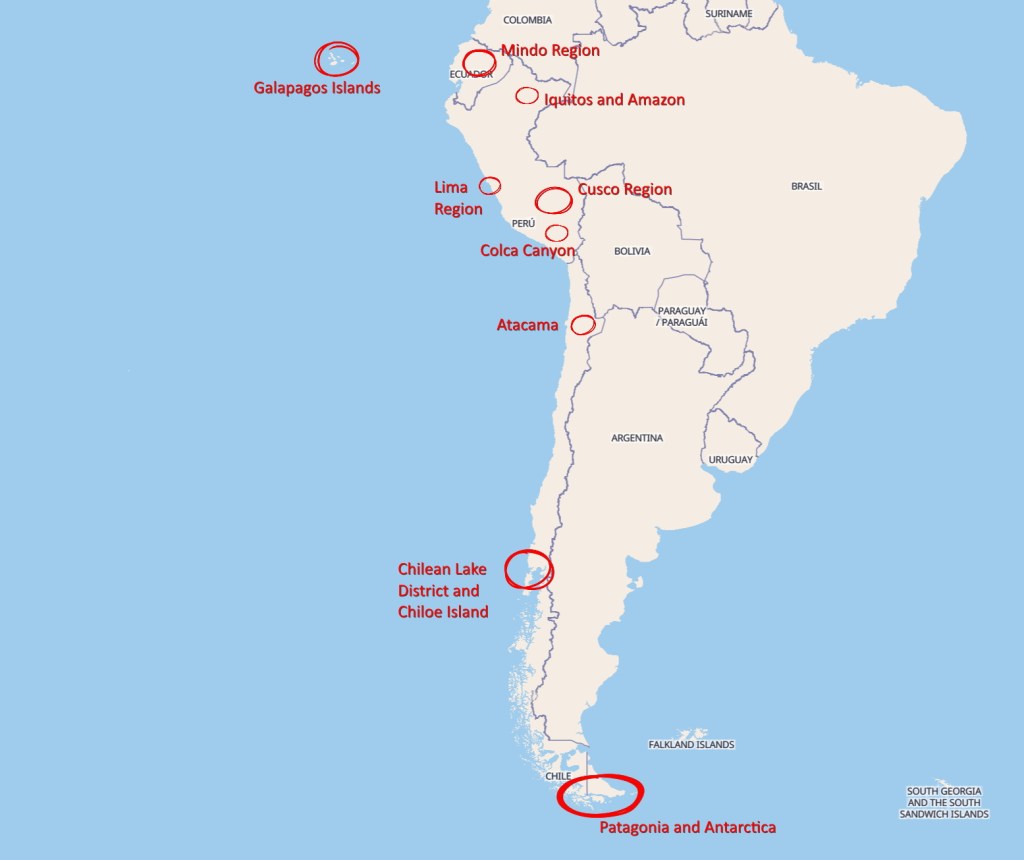
Of course there is much more to see in Peru/Ecuador/Chile than what I’ve circled above – but even with a leisurely four months to play with, there’s only so much you can realistically do – and as observed above, we’d prefer to visit fewer locations in a slower, more appreciative and considered way than rush from place to place. To that end we reluctantly ditched the Atacama (in Chile) section, as it would have involved more flights (or gigantic bussing or driving).
One thing we didn’t quite anticipate were the available flight connections, mostly available through LATAM Airlines; we decided to avoid the low-cost alternatives (SKY, JetSMART etc). Firstly, from Australia/New Zealand you can only fly direct into Santiago (LATAM/Qantas codeshare). Even worse, you can’t connect directly between Santiago and Quito. So there’s going to be a bit of flight-hopping involved.
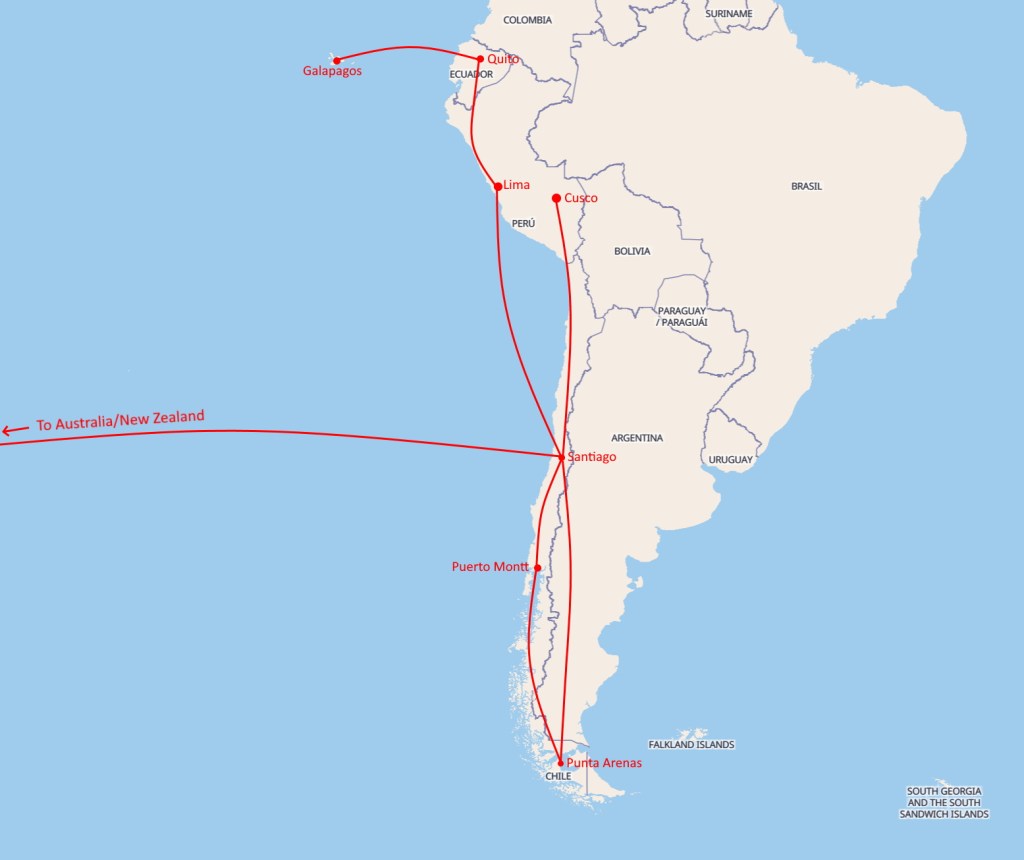
The broad itinerary we eventually chose was:
- Fly Sydney to Cusco, via Santiago
- Train to Puno (Lake Titicaca), then buses to Colca Canyon and Arequipa
- Fly Arequipa to Lima (this is a pretty short hop and could equally have been a bus)
- Fly Lima to Quito
- Fly to and from the Galapagos Islands from Quito
- Fly back to Santiago (via Lima, as there is no direct flight)
- Fly to Punta Arenas and do Patagonia/Antarctica
- Fly up to Puerto Montt and cover the Lake District and Chiloe Island
- Fly back to Santiago and from there back to Australia/NZ.
Phew, that’s a lot of flights!
Of note for internal travel, there is a company called PeruHop which runs ostensible hop on/hop off buses between major tourist destinations in Peru; a similar “Hop” service runs in Ecuador and Bolivia. This looked pretty useful, though it is really more of “here’s some tourist itinerary ideas you can choose from” service than a true hop-on, hop-off. Based on our reading of travel blogs and online discussions, we thought it best to avoid car hire/self-driving in Peru and Ecuador, opting instead for buses and paid transports (lodges often offer airport transfers for example). Our sole car hire situation would be for 2 or 3 weeks we planned in the Lake District in the south of Chile.
Our usual modus operandi when travelling is to book pretty much everything ahead of time. The downside is you can’t “go with the flow” as much, e.g. maybe you want to spontaneously decide to stay somewhere a bit longer if you happen to really like it. However, there are many places where you simply have to book ahead (the popular birding lodges in Ecuador, for example; or an Antarctica expedition), so we end up booking all of our accommodation, flights, transports and tours all 3 to 4 months ahead. Then we ended up with a very detailed master itinerary which we will simply execute day-by-day, having left in a bit of “fat” in there for contingencies/downtime (e.g. don’t book multi-day tours back-to-back…)
Another aspect of “planning ahead” here is that you have to visit a travel doctor (in our case in Australia) well ahead of time, and make sure you have all the required vaccinations and shots – especially for Yellow Fever. If you don’t have that, you might not get back into your home country (and you sort of want to have it anyway!)
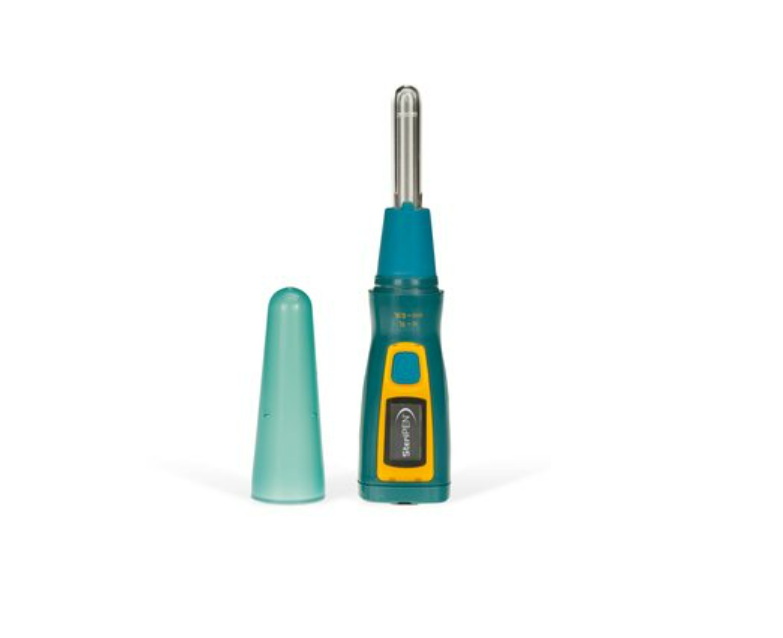
When anticipating packing for the trip, we also made sure to obtain a “SteriPen” – this is a good, USB-rechargeable water purification solution which is light and easy to carry and is very effective; it uses UV light to purify your water in only 90 seconds. It is not recommended for tourists to drink tap water in any of these South American countries without boiling or purifying it first.
Antarctica and Patagonia options
Because we were “forced to” fly into Santiago (hey I guess going to Chile probably ain’t that bad…) we looked hard at what there was to do in Chile. Who knows, it might be the one and only time we ever visit that country. Patagonia had always been a bucket-list destination for me, and it seems Antarctica is not too far away once you’re down that far south.
It turns out there is a bewildering array of companies that can take you on an Antarctic adventure, with many departure dates and durations and inclusions. Some of the big cruise lines (those obscenely huge “floating hotel”-type ships) operate here – though they typically don’t allow any landings on the ice. Smaller “expedition cruises” use ships with no more than 200 passengers and have (Zodiac-based) landings on the ice so you can get up close and personal with the penguins.
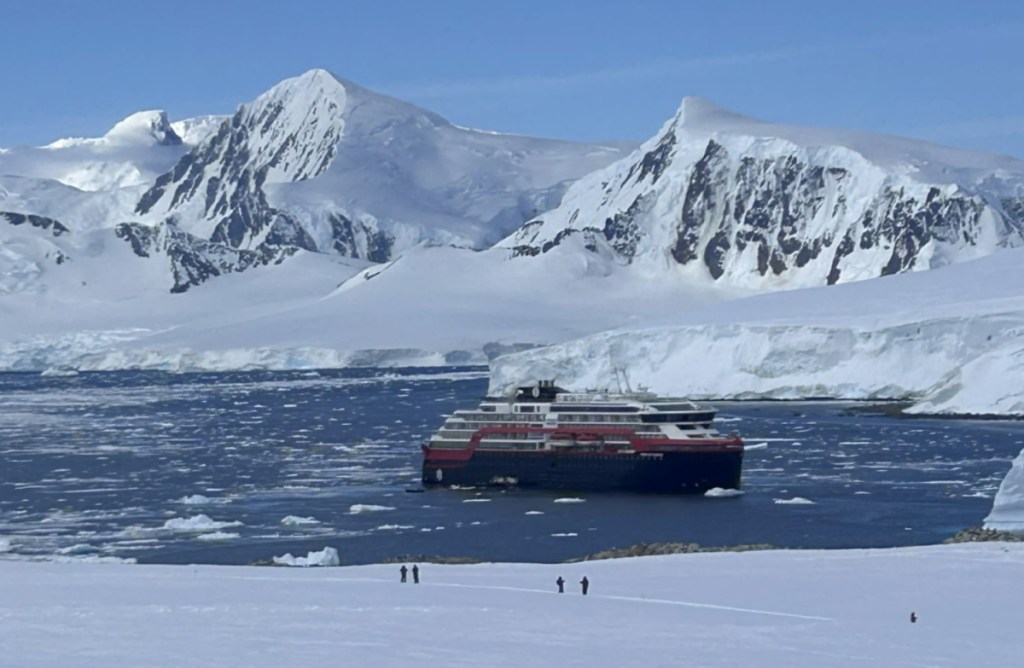
Companies that offer those smaller expedition cruises include HX Expeditions, Silversea, Aurora, Chimu, Swan Hellenic, Poseidon Adventures and many more, with the majority being based out of the port city of Ushuaia (in Argentina), some setting out from Punta Arenas (the main base for visiting the Patagonia region in Chile) and one or two from Puerto Williams (also on the Chilean side of the border). Not wanting to have to travel to Ushuaia (which is actually a 12 hour bus ride plus border crossing, each way, from Punta Arenas!), we settled on HX Expeditions. It sets out from Punta Arenas, and we chose their 23-day tour taking in the Falkland and South Georgia Island groups as well as the Antarctic Peninsula. This is a long cruise but we figured it’s a once-in-a-lifetime thing. Take note, here, that these cruises are very, very expensive these days. Hopefully it’s worth it!
One final happy note was that as we were in the planning stages, the formerly-onerous process of obtaining a tourist visa for Chile was completely dropped for Australian travelers, so we didn’t have to worry about that any more. Peru and Ecuador don’t require visas.
See subsequent blog posts to see how the adventure in Peru, Ecuador and Chile unfolded…

