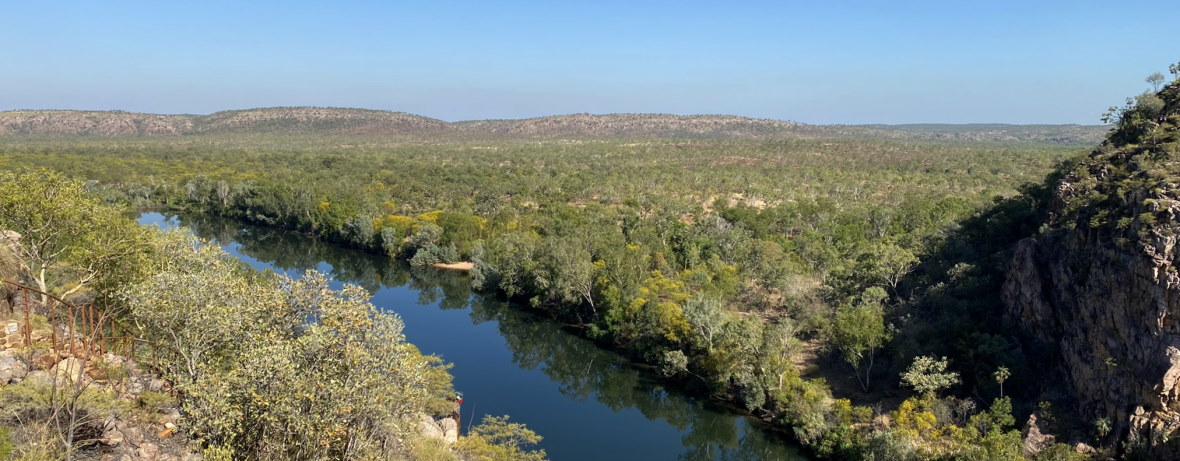
[A stop on the Litchfield + Katherine + Kununurra, Jul-Aug 2022 Trip]
Dates of visit: 31 Jul to 2 Aug, 2022
Katherine is an outback town in the Northern Territory some 320km south-east of Darwin. It has a number of birding hotspots that are worth a visit if you happen to be in the area, not least being Nitmiluk (Katherine) Gorge, famous for its scenic beauty. The Katherine Bird Festival has been held annually since 2018 and tends to centre around the gorge. This post will cover that area and a few more; note that the northern Edith Falls section of Nitmiluk National Park, more well-known for Gouldian Finch and Hooded Parrot sightings, was covered in a previous post.
Nitmiluk / Katherine Gorge
This impressive sandstone formation is around 30km north-east of the Katherine township and offers an array of walking tracks, a well-appointed visitor centre, and river cruises up the gorge. Note that on the way (10km from Katherine) is a notable birding hotspot called Donkey Camp Weir, where Great-billed Heron and various Bitterns are sometimes seen.

The shortest hike is the Baruwei Lookout Walk, of 1.8km. You can turn this into a longer 3.7km loop and there are several much longer walks on offer too. Desirable birds to find in the rocky areas are Chestnut-quilled Rock-Pigeon and Sandstone Shrike-thrush, but you will need to take care as temperatures soar as the morning progresses and dehydration and heatstroke can become real possibilities if you spend more than an hour or two in the sun.
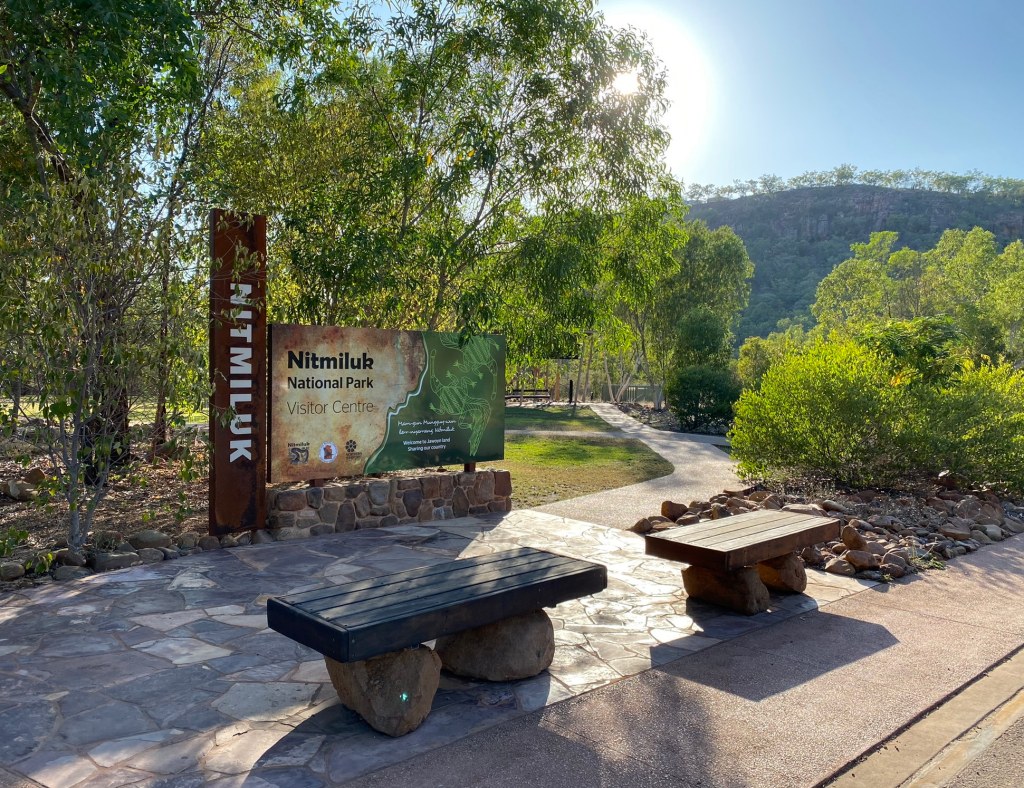


Like most of the NT’s prime tourist attractions, there’s sealed roads and plenty of parking and facilities here. The visitor centre has an excellent cafe and gift shop and an amazing view out across the landscape.
The start of the Baruwei Lookout Walk is paved and leads to a lush riverside park; a short side road leads down to where the boats leave from.


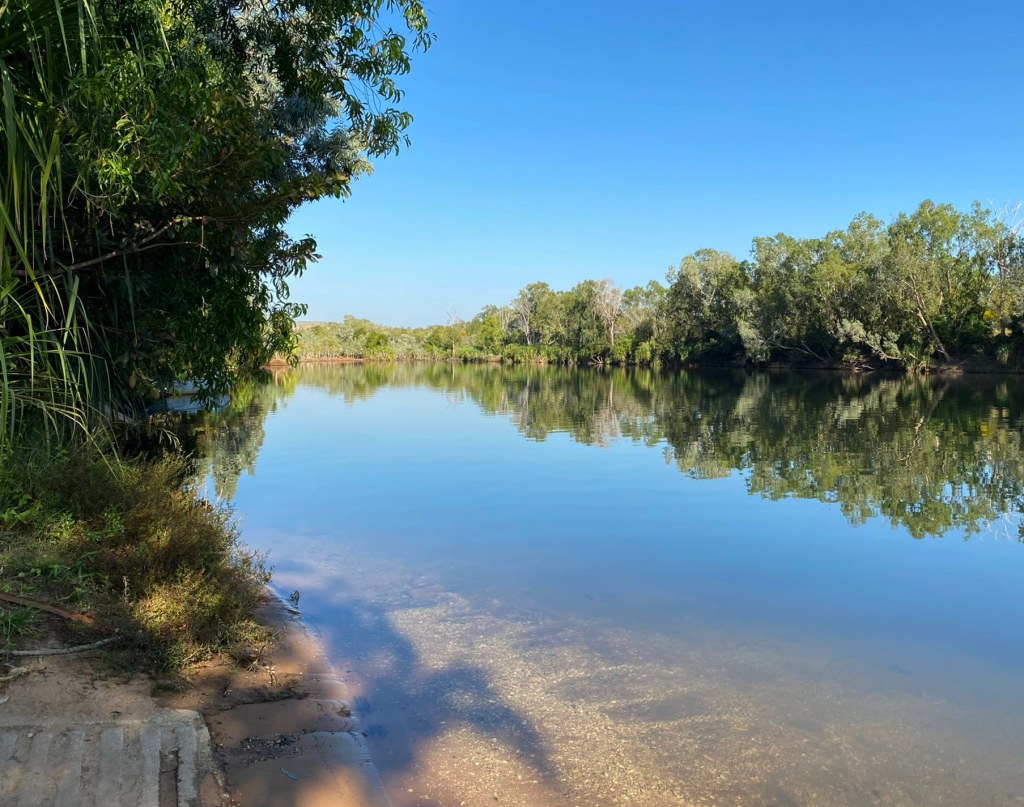
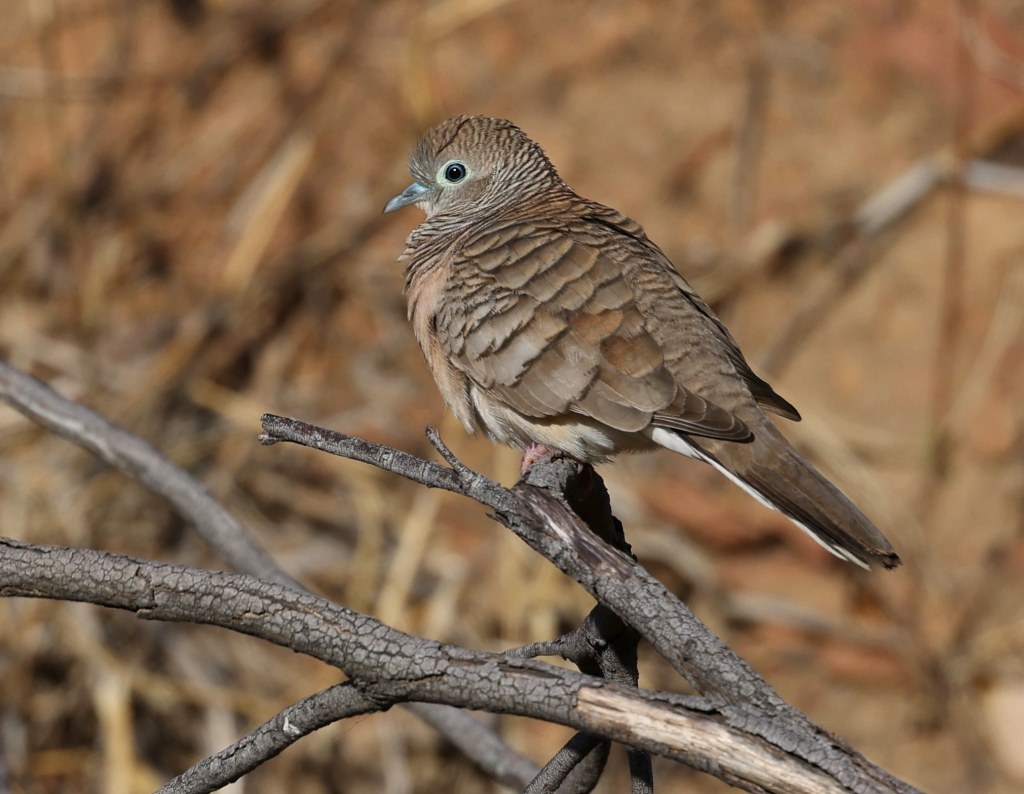
Along this path we saw Diamond Dove and Peaceful Dove, as well as a Rufous Whistler.

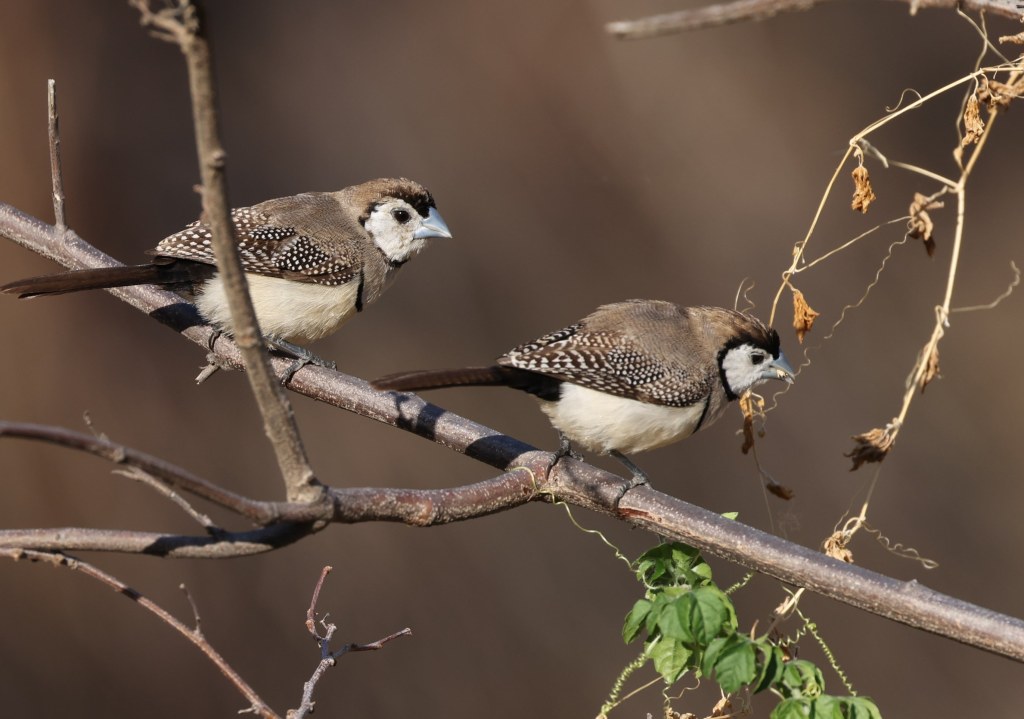
Five Double-Barred Finches were hopping around in the brush quite close to the path, and they were good value to watch for a while.
Dusky Honeyeater and Brown Honeyeaters were here though we also saw Rufous-Throated, White-Gaped and Blue-Faced Honeyeaters during the course of the morning.


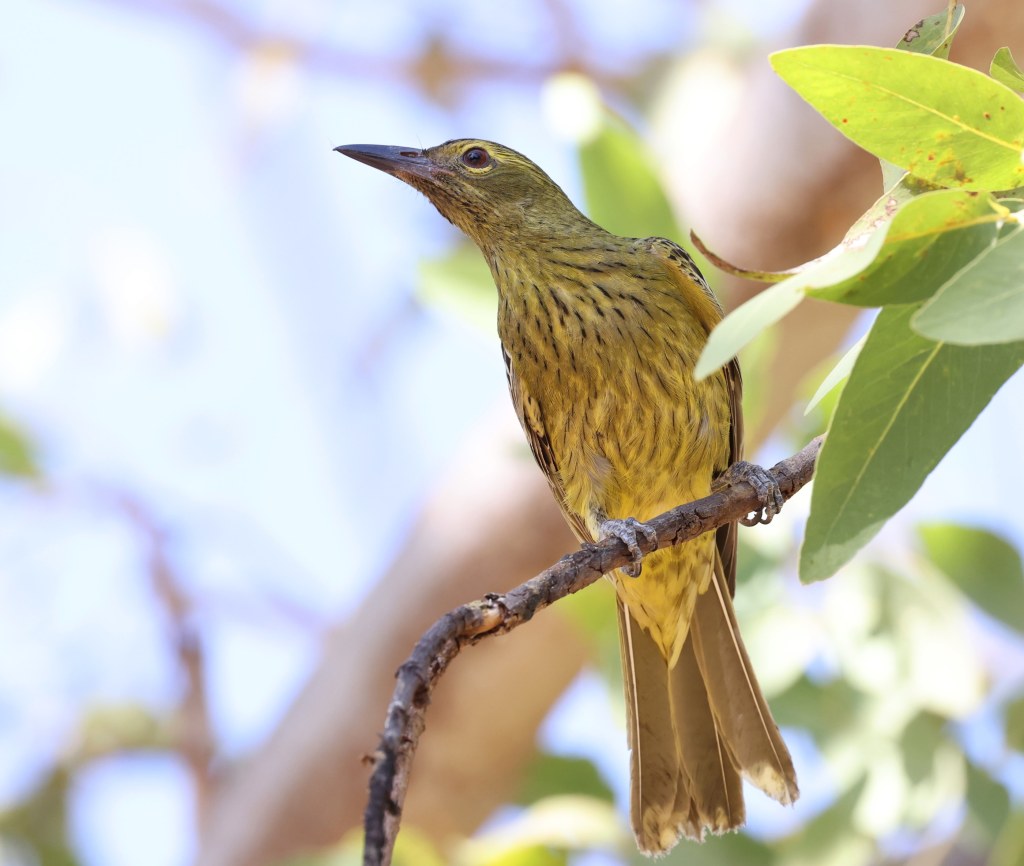
In the shady park a lovely Yellow Oriole called from a low branch; they are also called Green Oriole and even Yellow-Bellied Oriole. I prefer the term Green Oriole myself…

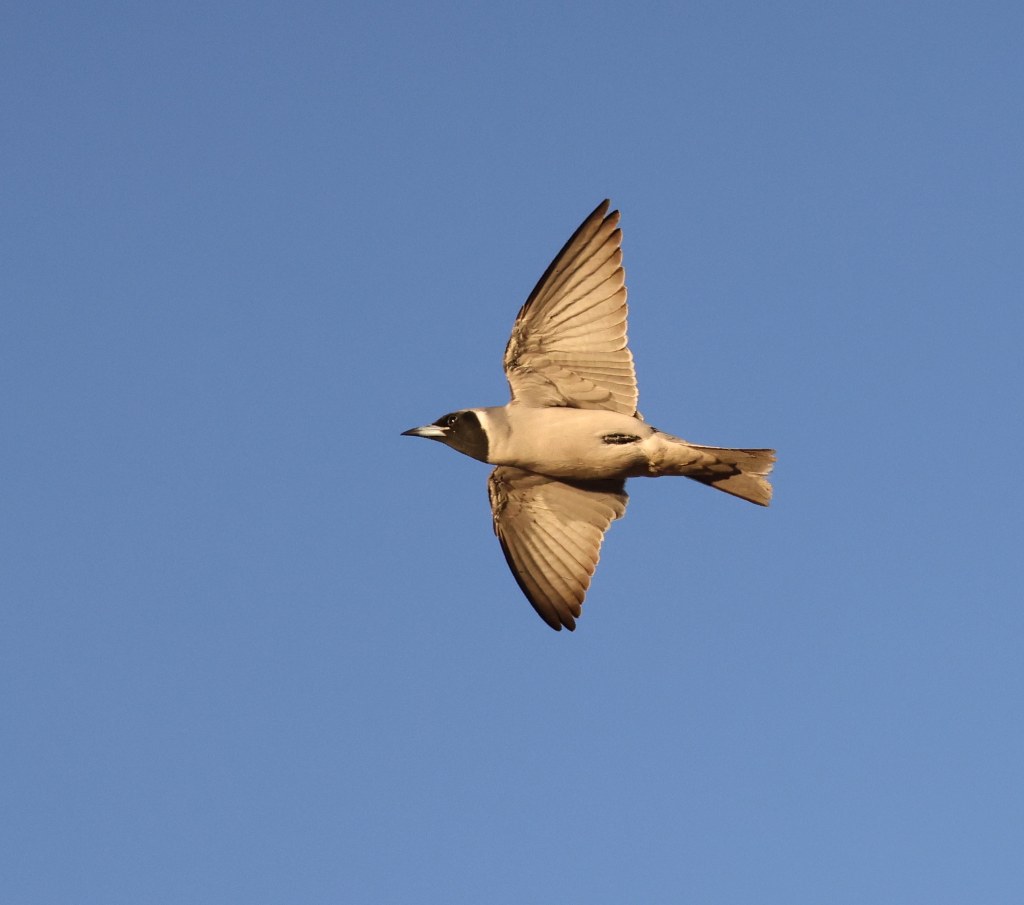
By the river, where the cruises are serviced by metal open-sided flat-bottom barges, we observed a couple of White-Breasted Woodswallows dipping down for a drink and it was an opportunity to try the challenge of an in-flight shot.

Later in the walk we saw woodswallows circling and close scrutiny showed that the majority were Masked Woodswallows, with a couple of Little Woodswallows thrown in for good measure.
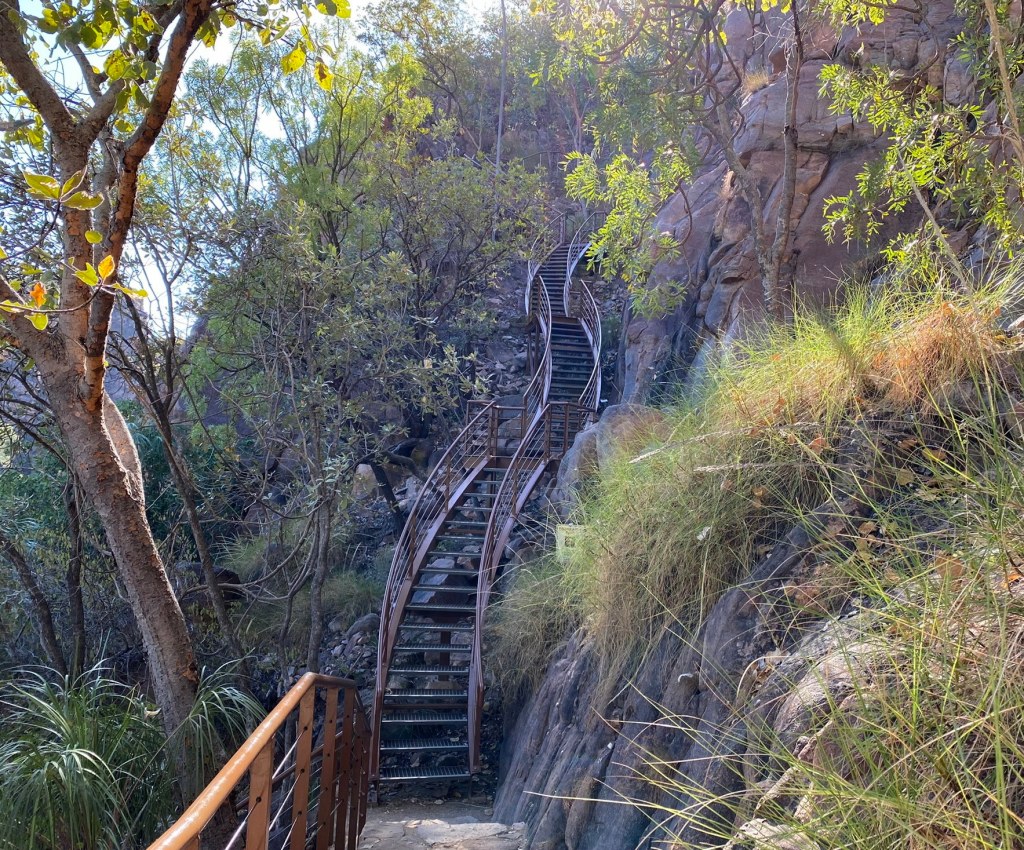
The walk becomes more challenging as it follows the river line and ascends sharply towards the lookout, which is at the top of the gorge cliffs. There are plenty of steps to negotiate but there are handrails and it isn’t difficult as such.


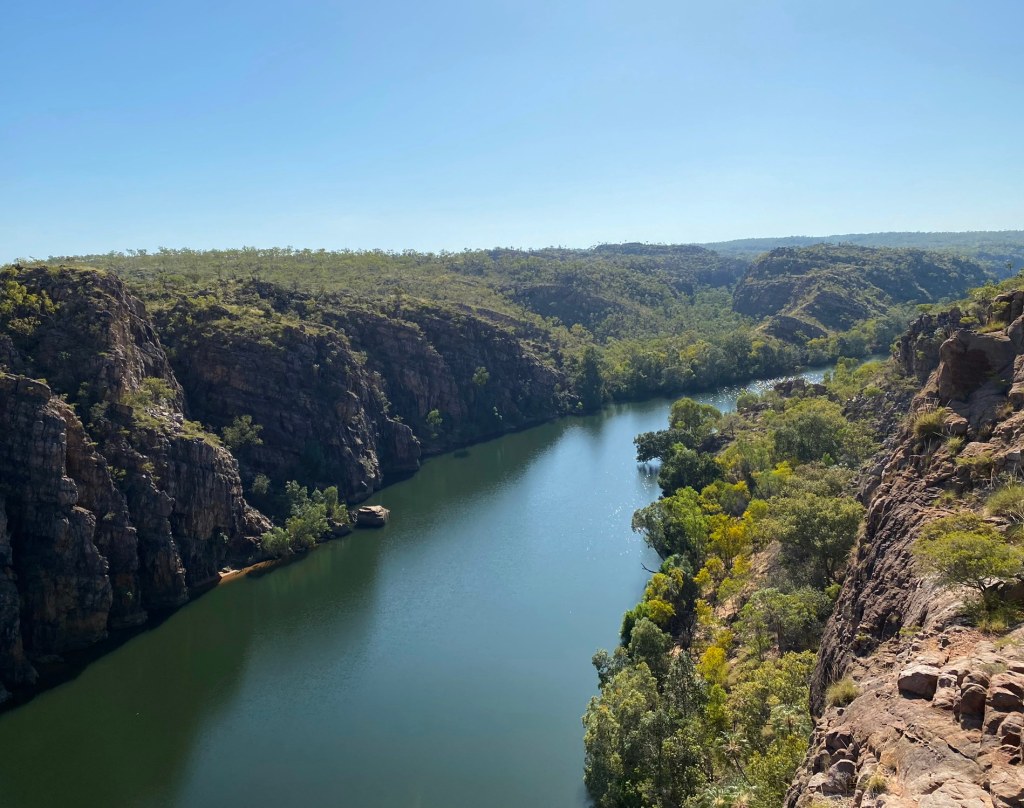
Views from the top are excellent, helped by a large overhanging wooden balcony. We could even see some Rainbow Bee-Eaters cruising far below our vantage point. This is the kind of lookout where you can really relax and drink in the outback scenery.


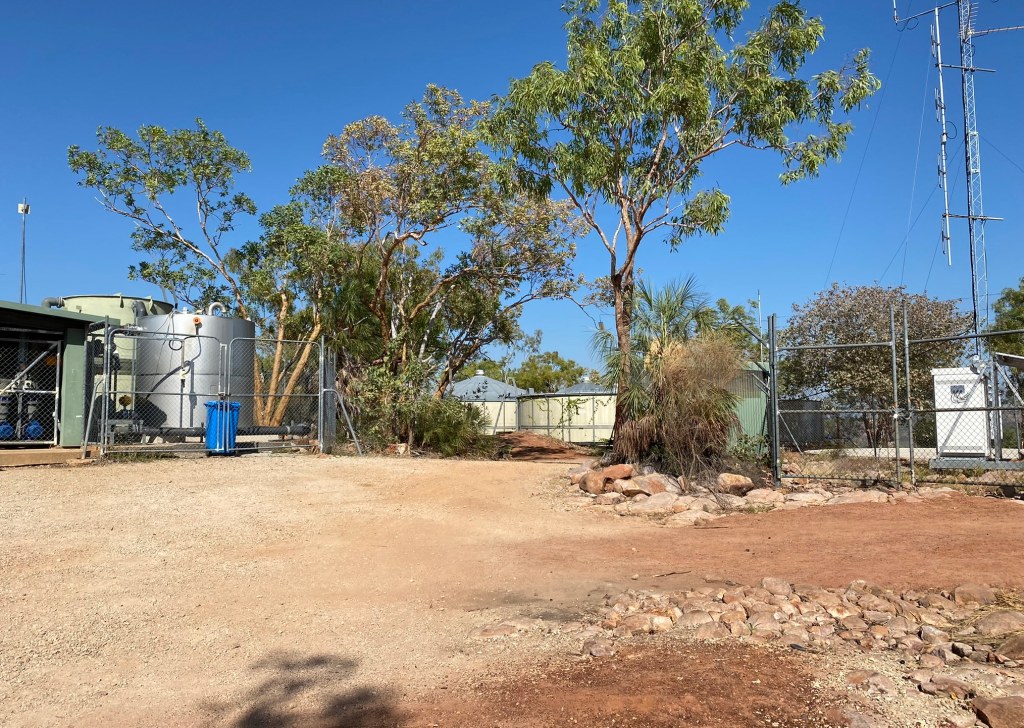
If you continue past this point you’ll likely lose the cooling breezes from the river, and the path becomes stony and hard as it heads away from the gorge itself. It’s not a difficult path at all; the heat will be the main thing to contend with.


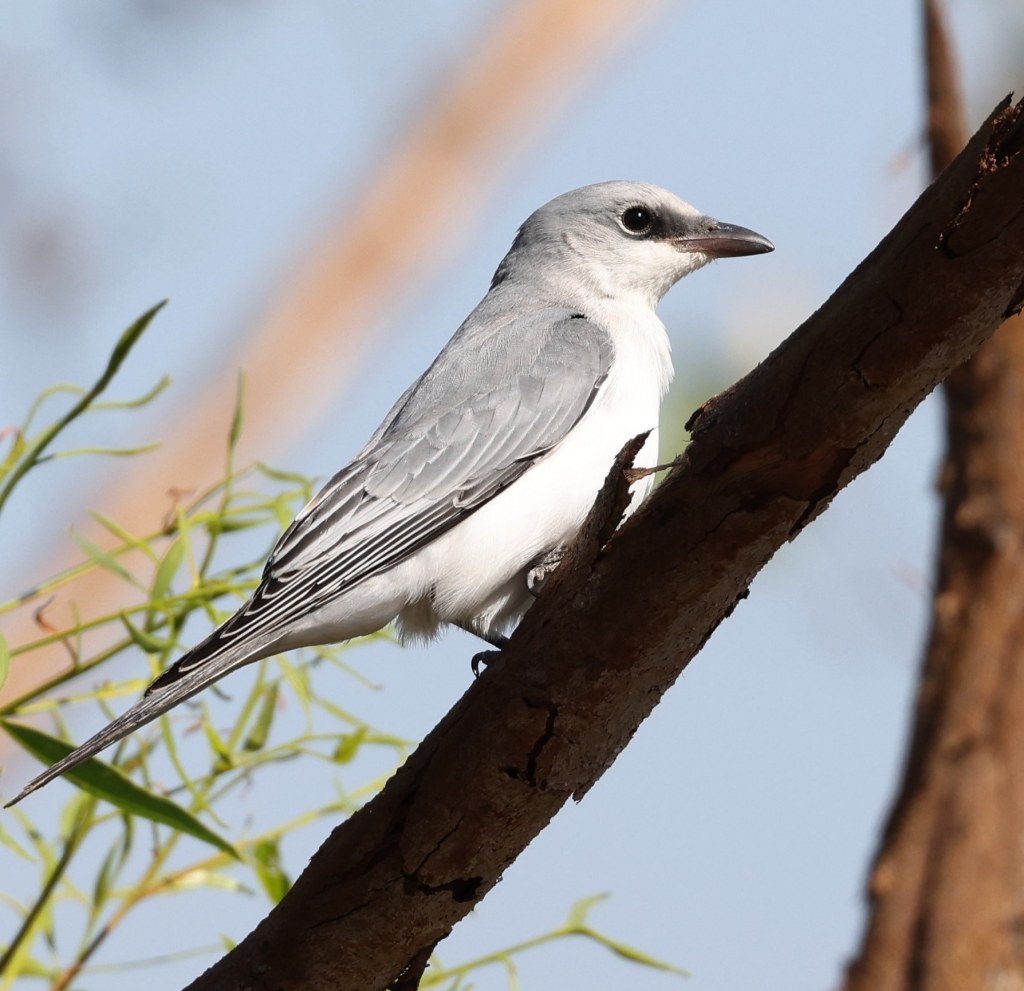
As for birds, there are less here than down by the river. Highlights for us were the aforementioned woodswallows (much pointing of cameras straight up at the sky), and a lone White-Bellied Cuckooshrike.

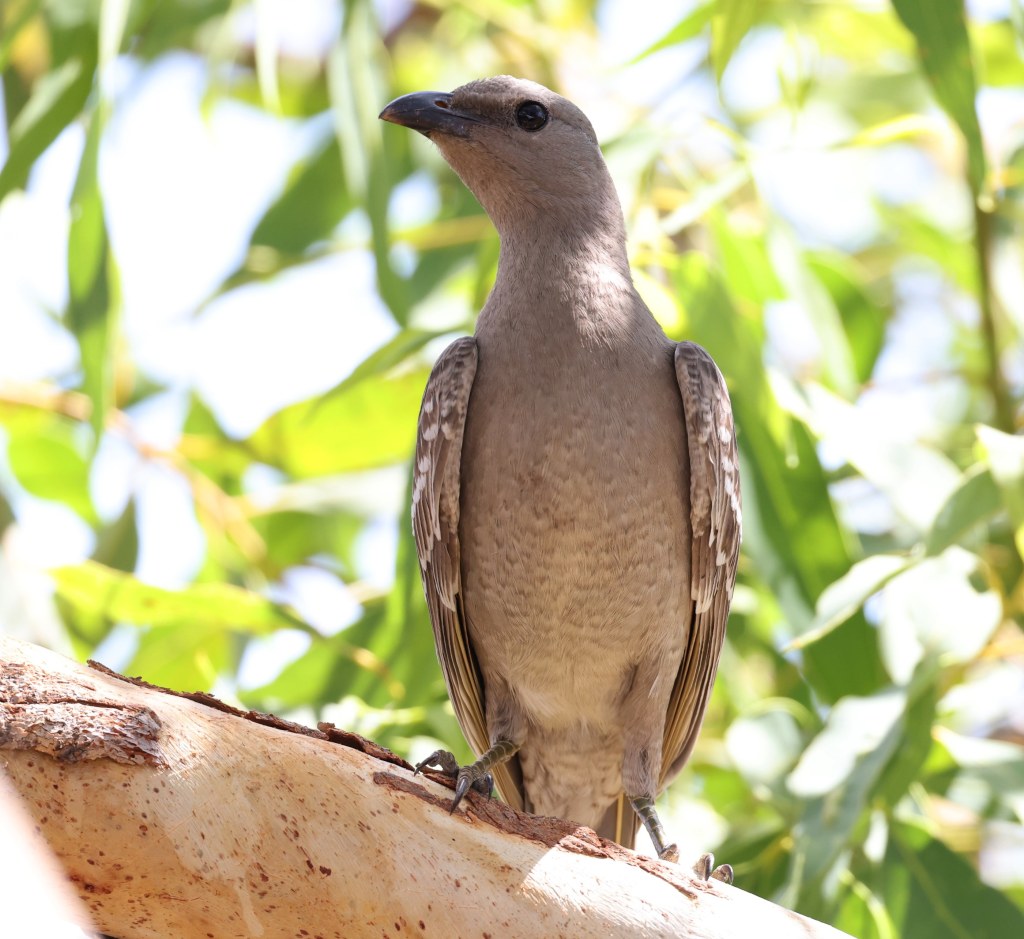
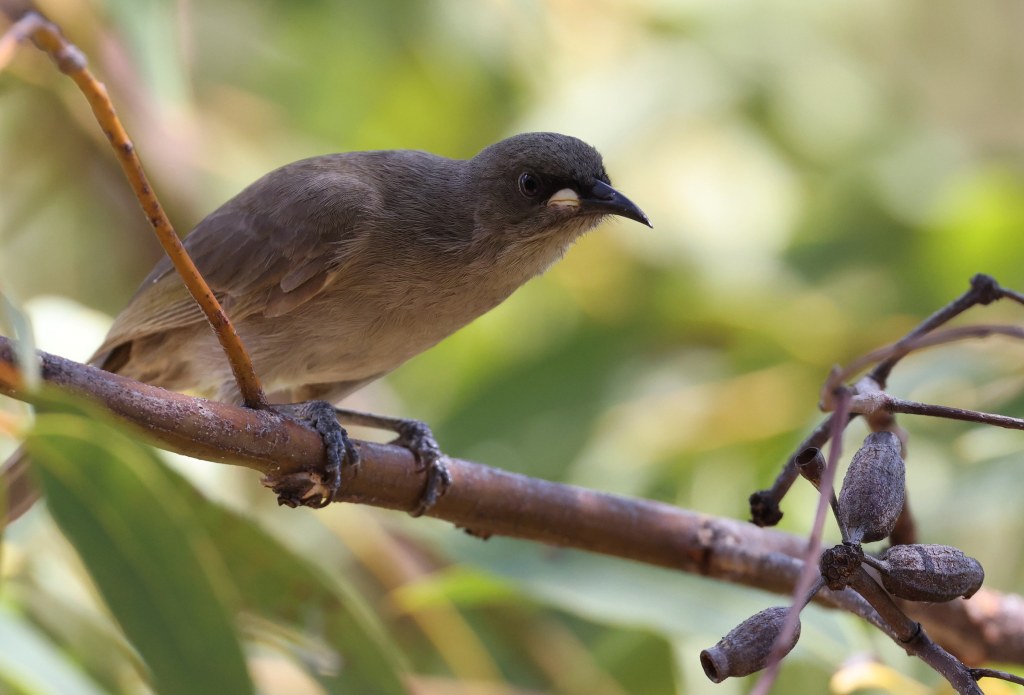
Back at the visitor centre we hit up a plate-of-chips-followed-by-ice-cream, a classic combo, and ate on the deck. Our meal was accompanied by some bird-watching, first observing the scavenging antics of a Blue-Faced Honeyeater and a Great Bowerbird, while White-Gaped Honeyeaters foraged and hopped about the tall trees at eye level with the deck.
In all we picked up 33 species in a little over 3 hours of birding. Raptors included Black and Whistling Kite, with flyovers by a dozen Red-Tailed Black Cockatoos and a Red-Winged Parrot. As a place for combining amazing scenery and reasonable birding, you could do worse!
Around Katherine
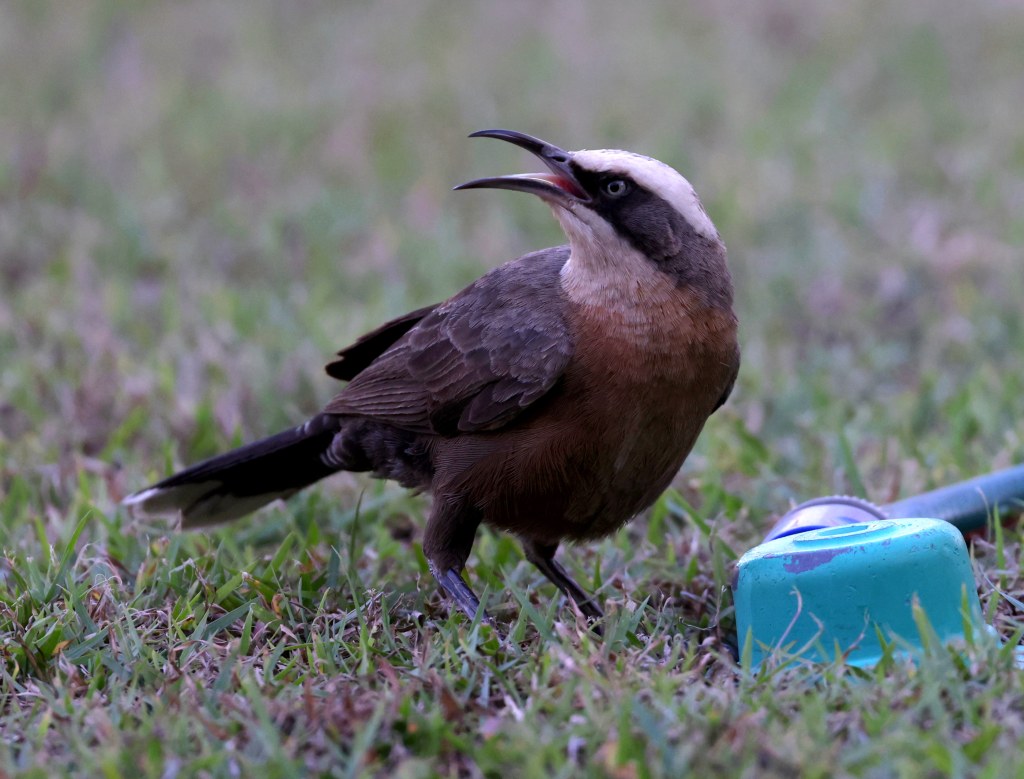
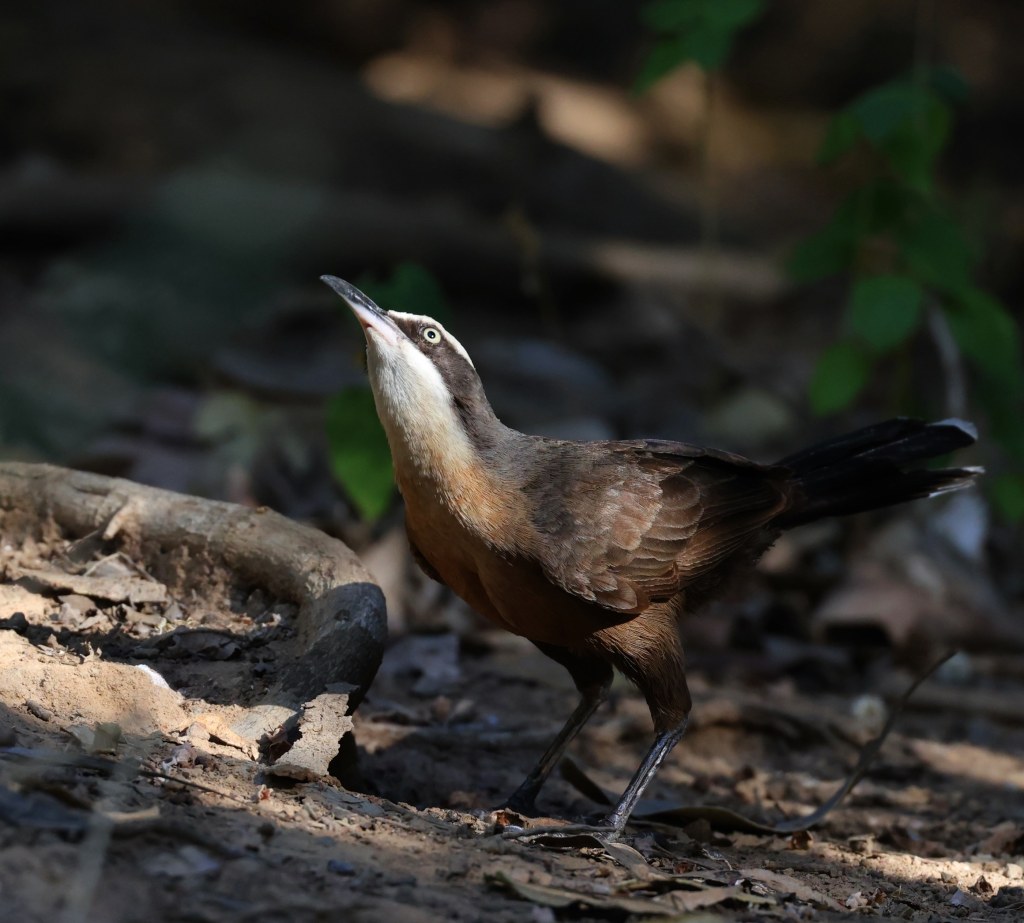
Like many small outback Australian towns, birds seem to treat Katherine like it’s just part of their countryside. You’ll see birds right in town and in the yards and parks that you’d normally expect to have to trawl through proper bushland to see. A case in point are the Grey-Crowned Babblers which we found sipping from a sprinkler in the yard of our hotel. I had previously seen them in the crown of a tree right in the centre of a busy Mount Isa street, so this wasn’t entirely novel for me, but it was still pleasant to see.

Over one of the largest parks in Katherine we observed a huge funnel of many dozen Black Kites. These birds are very commonly seen on outback roads especially where there is roadkill but seeing them in huge numbers is something else again.

On our way to a birding site one morning we couldn’t resist stopping to watch some Red-Collared Lorikeets pecking around the grass by a busy road in the town.

Katherine Hot Springs
Not far from the centre of town along a stretch of the Katherine River are some thermal springs – basically a chain of clear pools surrounded by shady trees. They are very popular with the locals who come in droves to swim in the constant 25 to 30 degree waters. Not so us, we were there for the birds!
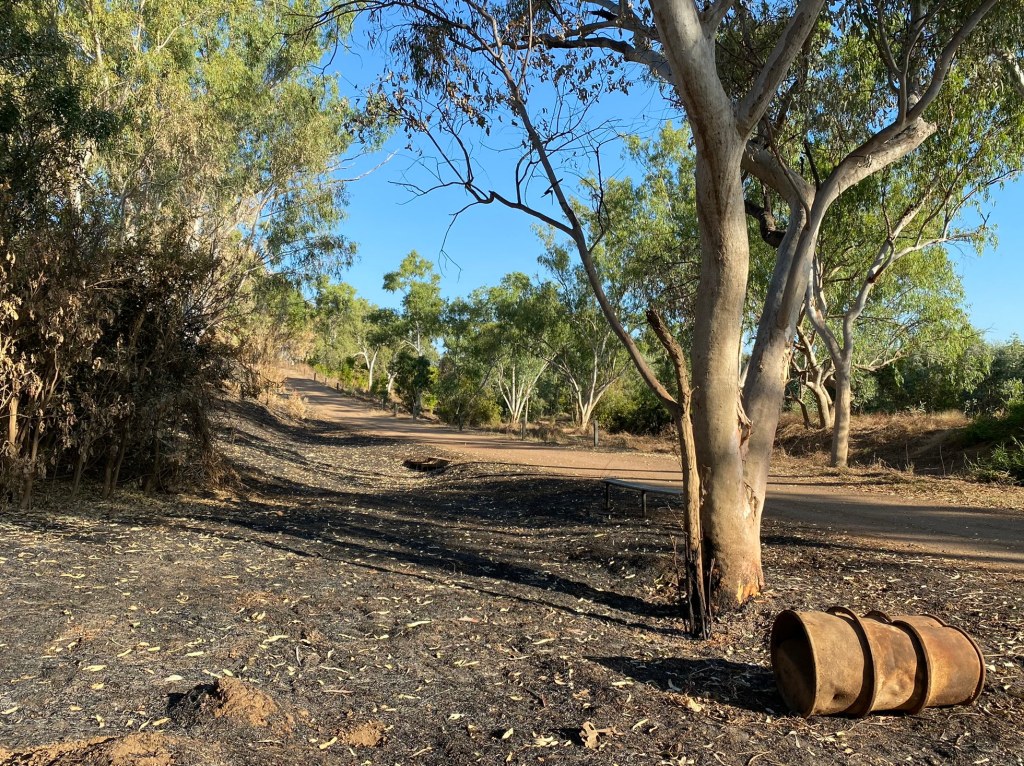
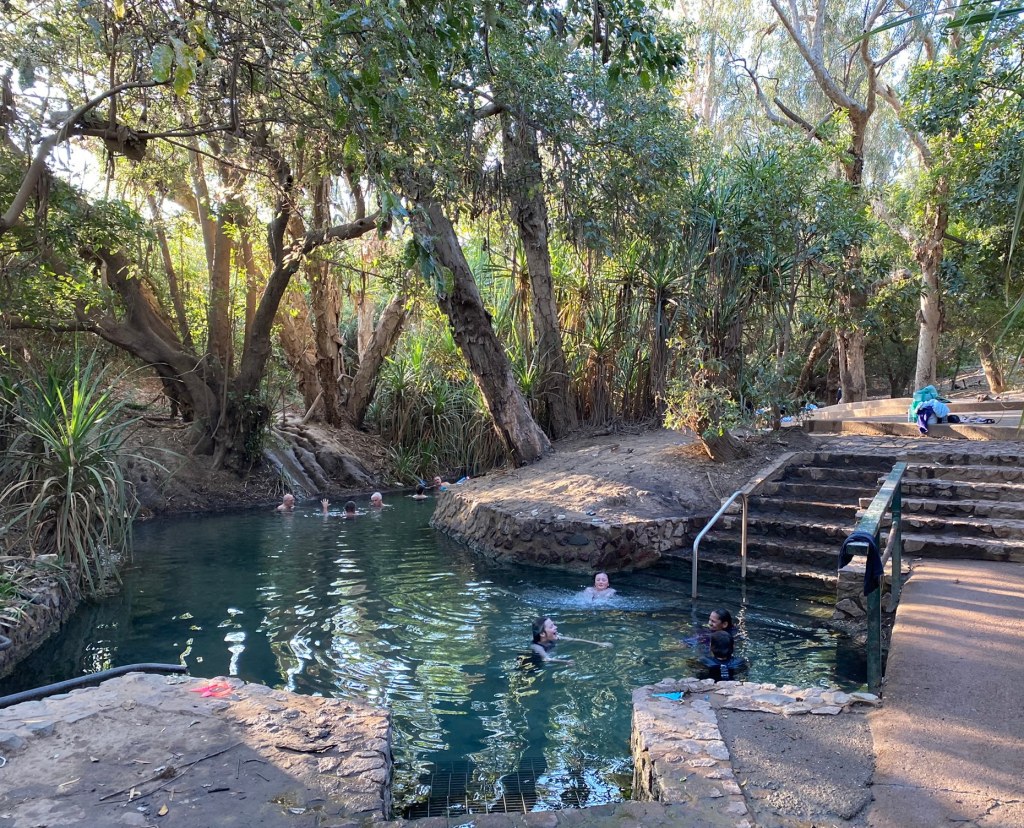

There is a walking/bike path on both sides of the river, with a good birding stretch of about 3.5km between bridges. There is plenty of birding here, and we saw some Grey-Crowned Babblers (of course) and a Yellow (or is it Green?) Oriole nesting up high in a tree.

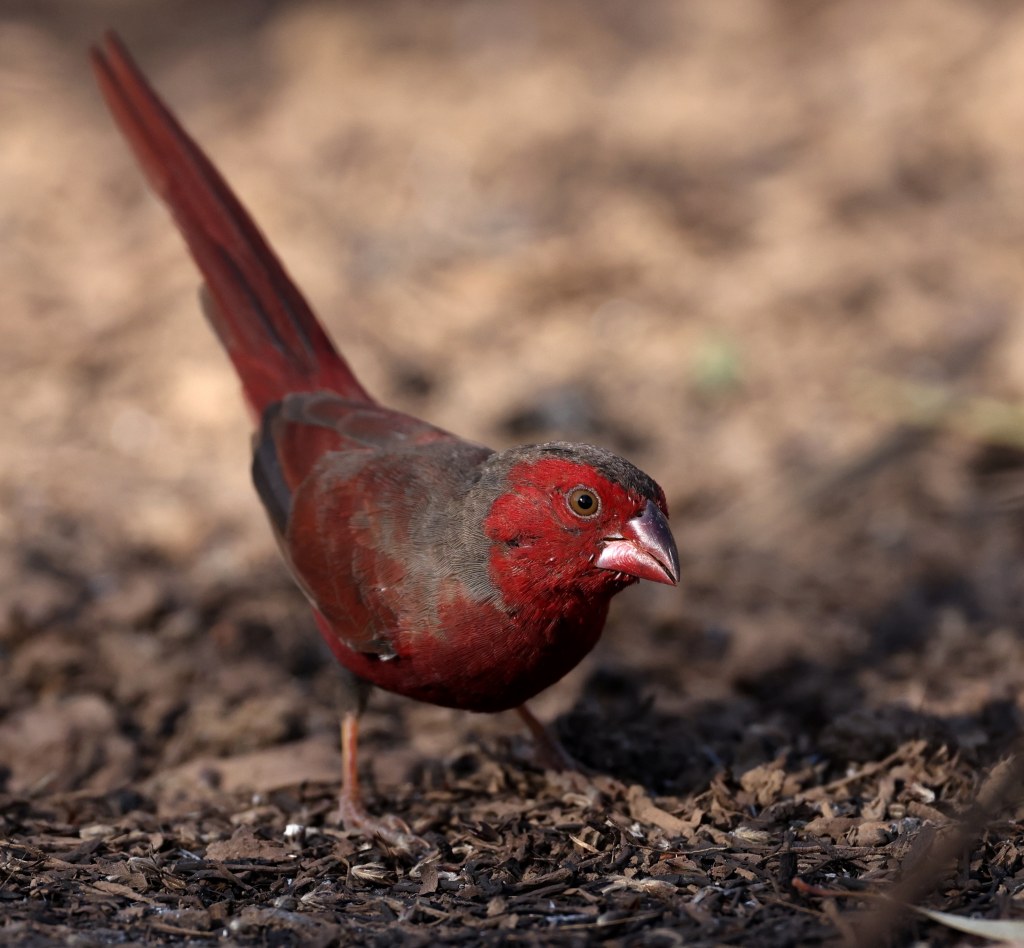
The highlight of this birding session were the finches (this was a finch-chasing trip, after all), especially the Crimson Finches. On one side of the track there was some burned out ground, which to the casual observer looked like little more than charcoal, but the finches were getting right stuck into it – whether they were finding seeds or bits of charcoal (apparently an avian digestive aid) I wasn’t sure, all I knew was we were having a terrific time watching them. A couple of curious passers-by asked us what they were and we were happy to point out and name the “little red birds”.

Double-Barred Finches – an equal number to the twenty Crimsons present – also joined in the fun, while we then saw Paperbark Flycatchers and a Rainbow Bee-Eater having some digestion issues.

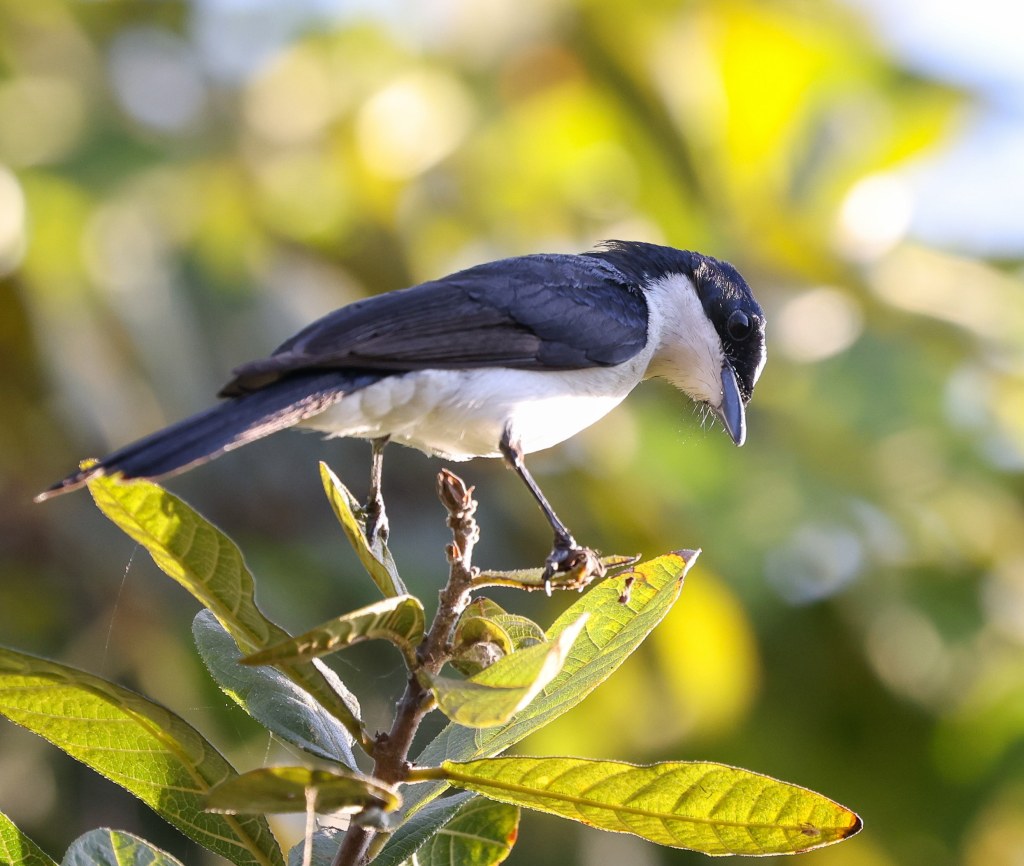
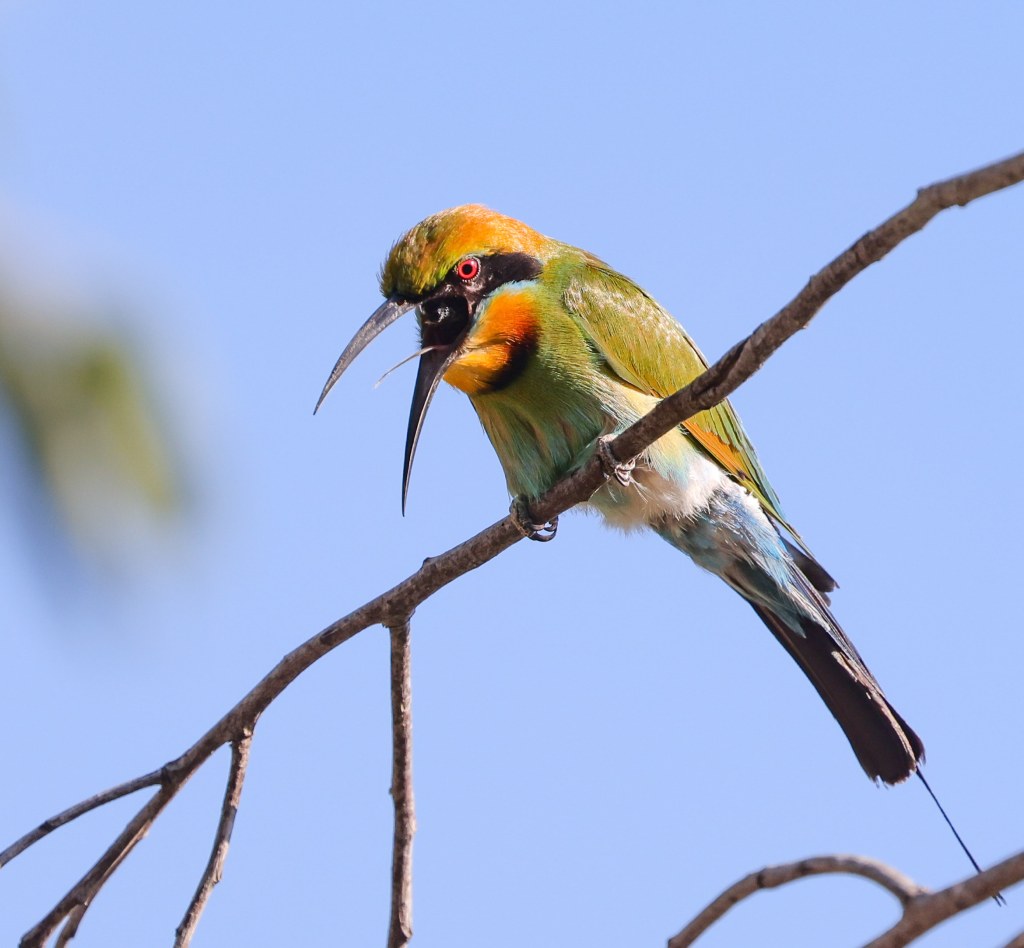
The afternoon was capped off with a Straw-Necked Ibis in excellent light strolling through the car park, its wing feathers glistening iridescently.

Katherine Low-Level Reserve
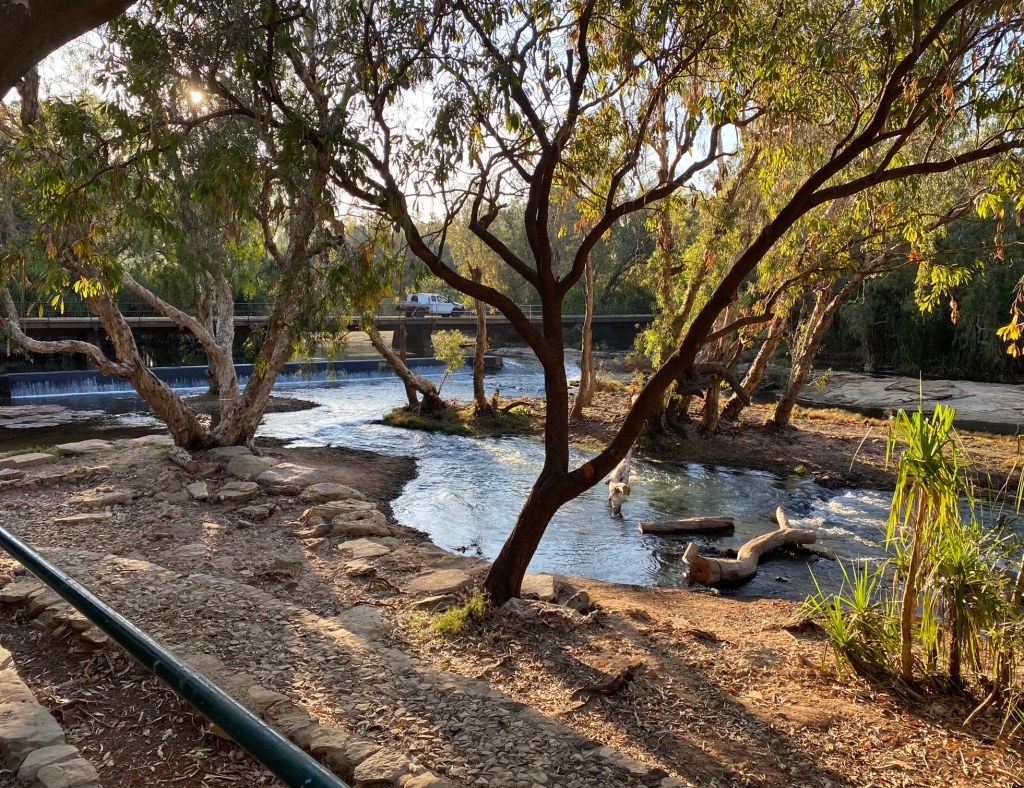
A little further to the south of the hot springs lies the 105-hectare Katherine Low-Level Nature Reserve, so named because it gets rather inundated by water during the wet season (December to April). Apparently the low-level bridge (only 6 feet above the dry season water level) and weir were built by US troops stationed nearby during World War II. Aside from the birds, it is also the site of a very large (and noisy) bat colony (technically, red and black flying foxes).

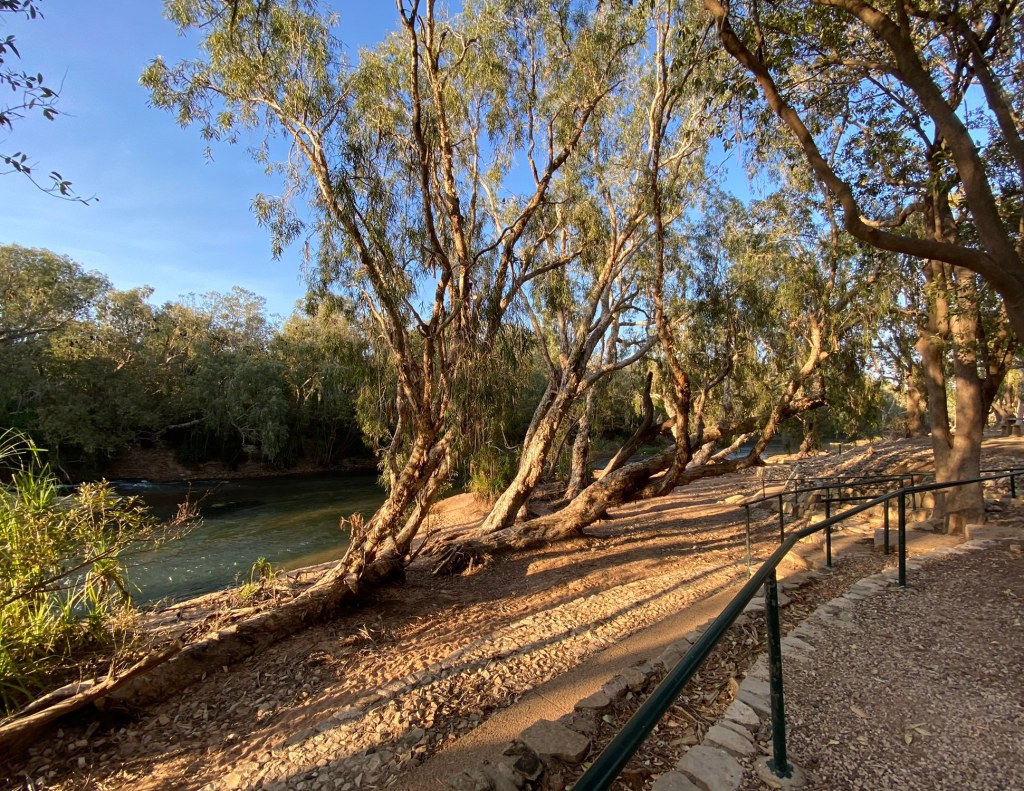
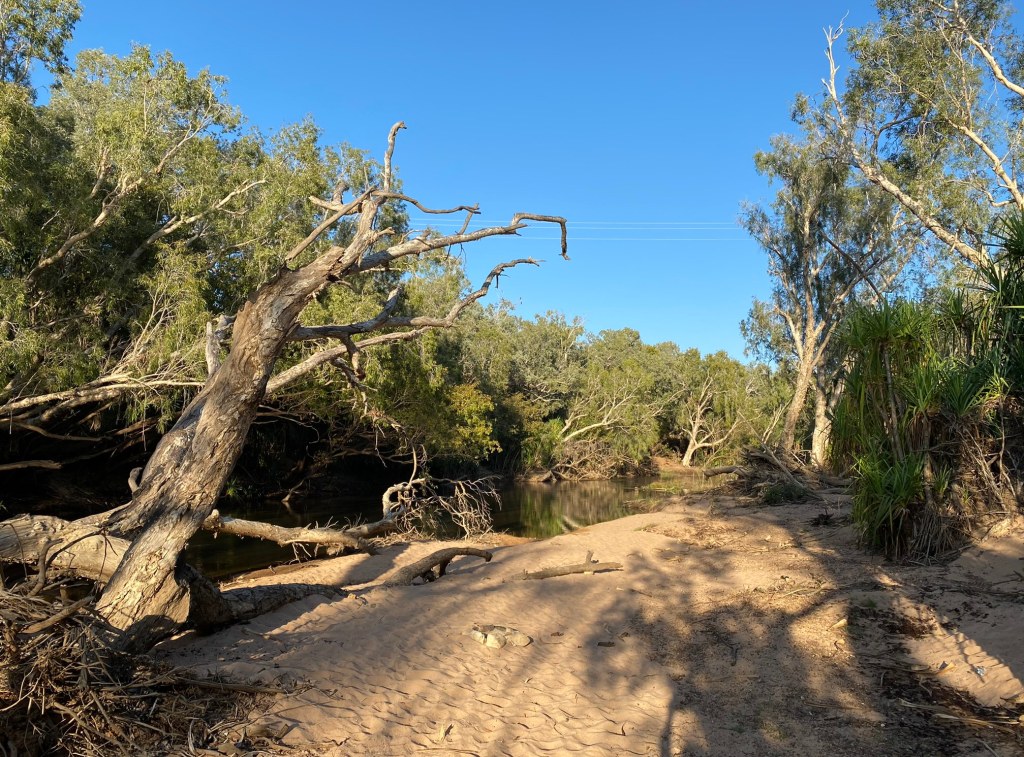
This location has more of a wild, “free-for-all” vibe than some others we visited. It follows the river – really more of a creek in the dry season – without any formal paths. It is sandy or rocky underfoot with plenty of bits of debris and fallen trees and branches around.
A Little Egret was one of the first birds we saw here and there was an opportunity to photograph it with a dramatic dark background – basically you can just ramp down your exposure compensation (or equivalent ISO/shutter speed combination) when it is such a bright white bird with a relatively dark background, and voila, you have a clean shot.

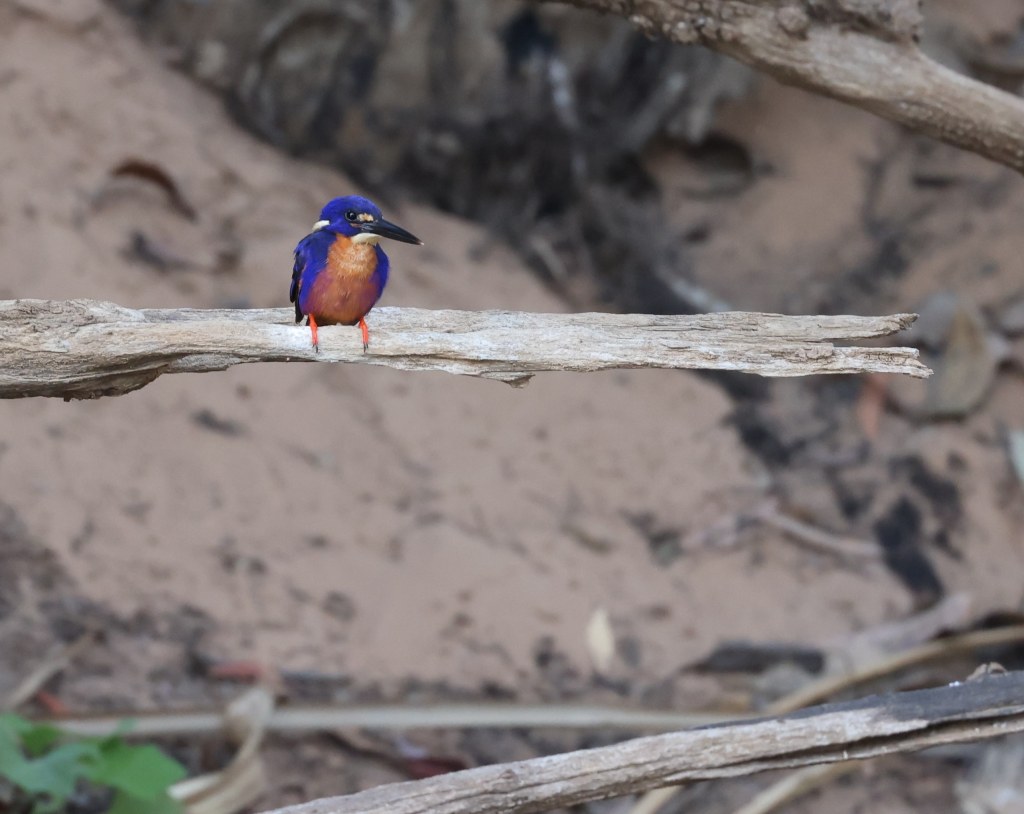
An Azure Kingfisher was a welcome sight but too skittish to approach closely, while yet another Yellow (Green?!) Oriole put in an appearance.

This session belonged to the ten Black Kites though, who were cruising along the waterway, perching menacingly, and generally just behaving like they owned the place.


The Low Level Reserve provided a counterpoint to more populous birding spots around town, with a more out-there feel to it despite being on the edge of town.
Wastewater Treatment Plant
Around 5km south of town on Novis Quarry Rd is the Katherine Wastewater Treatment Plant. It may seem like a distasteful place to go birding, but places like these – especially in the outback, where bodies of water draw birds like magnets – they can be very productive.
The prospect of large numbers of woodswallows (seen on previous eBird checklists) was what primarily drew us to this location, because who doesn’t like woodswallows? But the site also has many interesting birds that visit – Little Curlew (summer), Oriental Plover and Oriental Pratincole (mainly Oct/Nov/Dec), Marsh and Wood Sandpipers, Flock Bronzewing, and sometimes Eastern Yellow Wagtail.
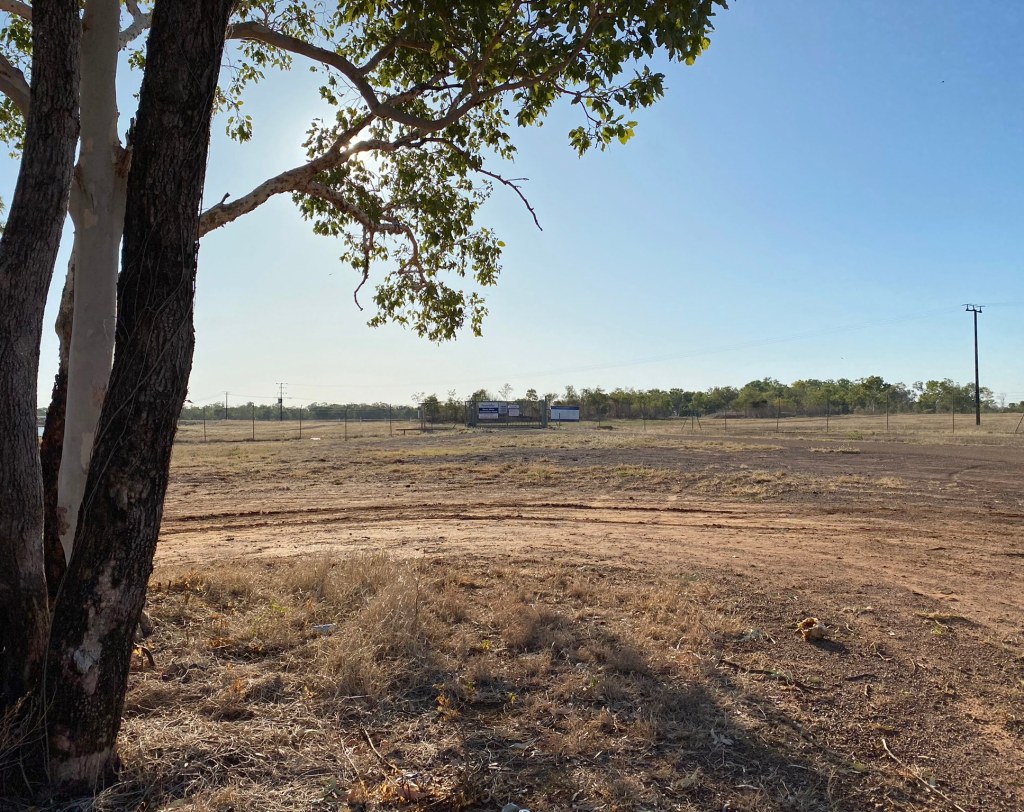
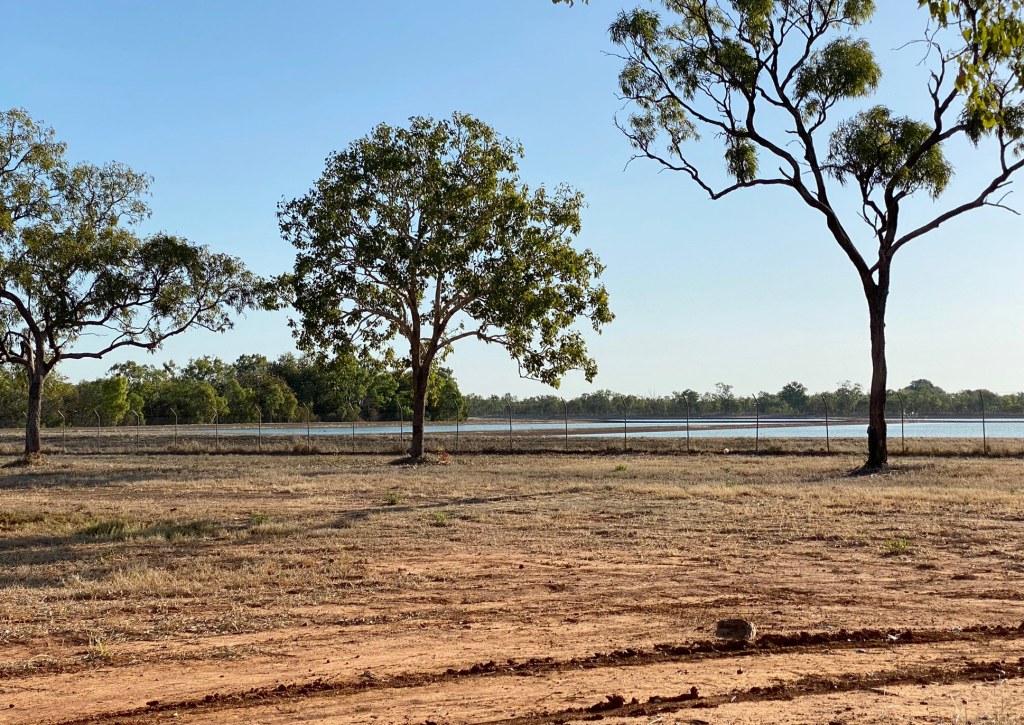
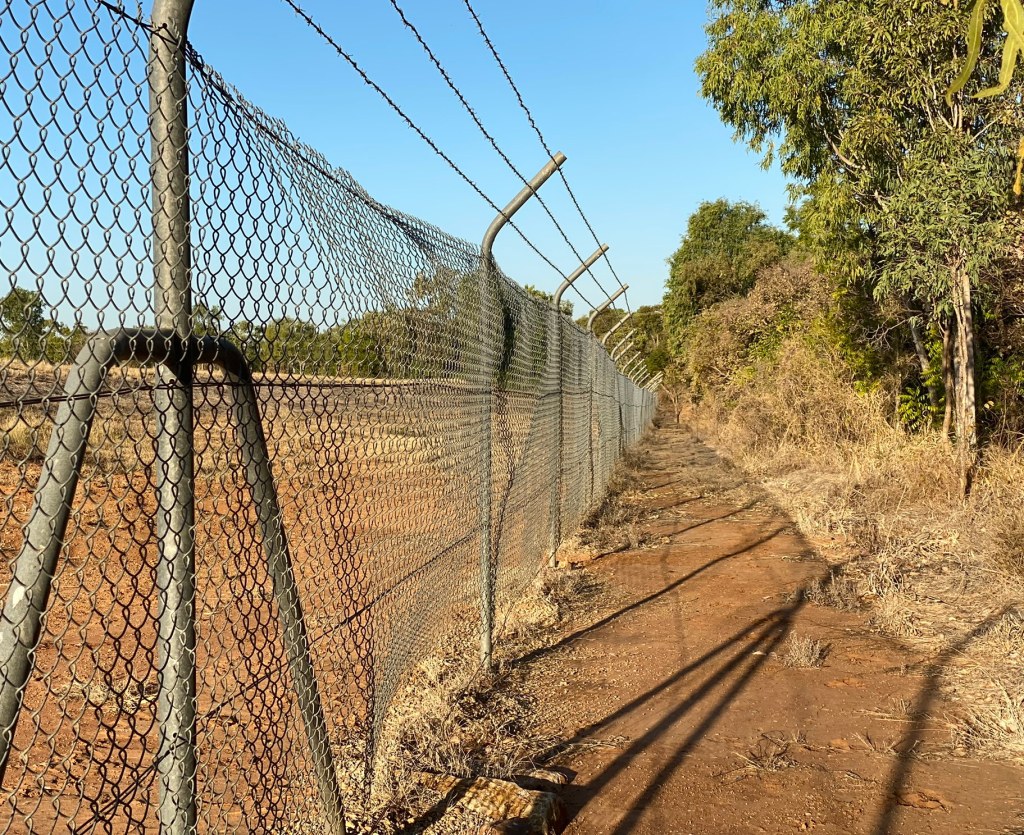
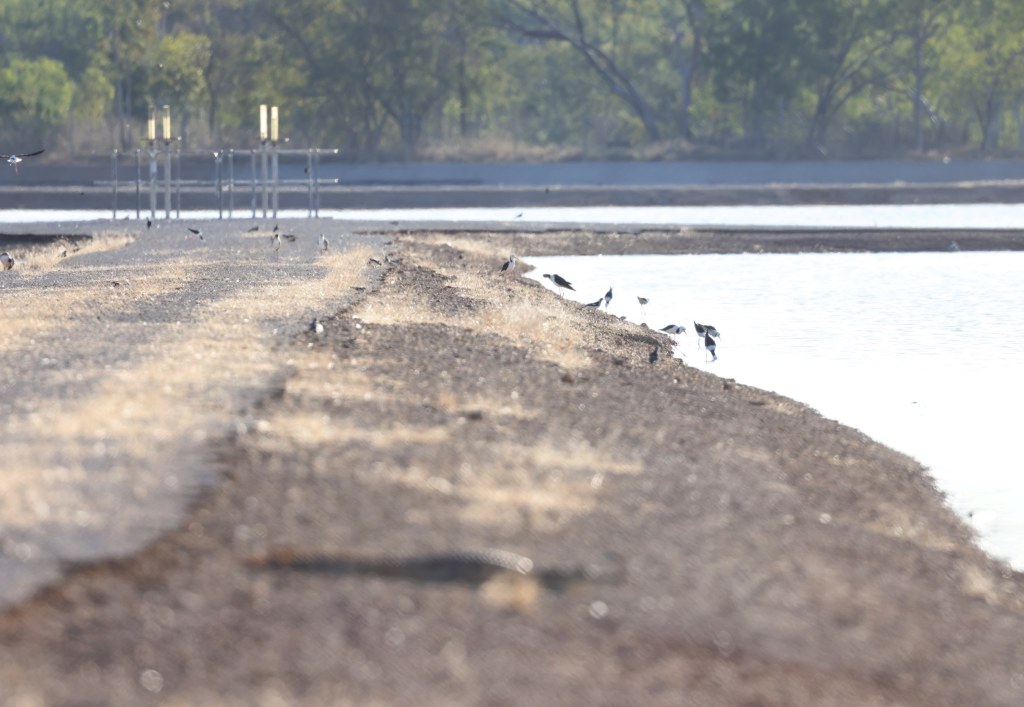
I am not sure if you can access the interior of the site, but you can see most of it from the perimeter fenceline, which is around 2.5km if you were to traverse the whole thing. We concentrated only on the southern side, starting from the entrance gate and following the fence around.
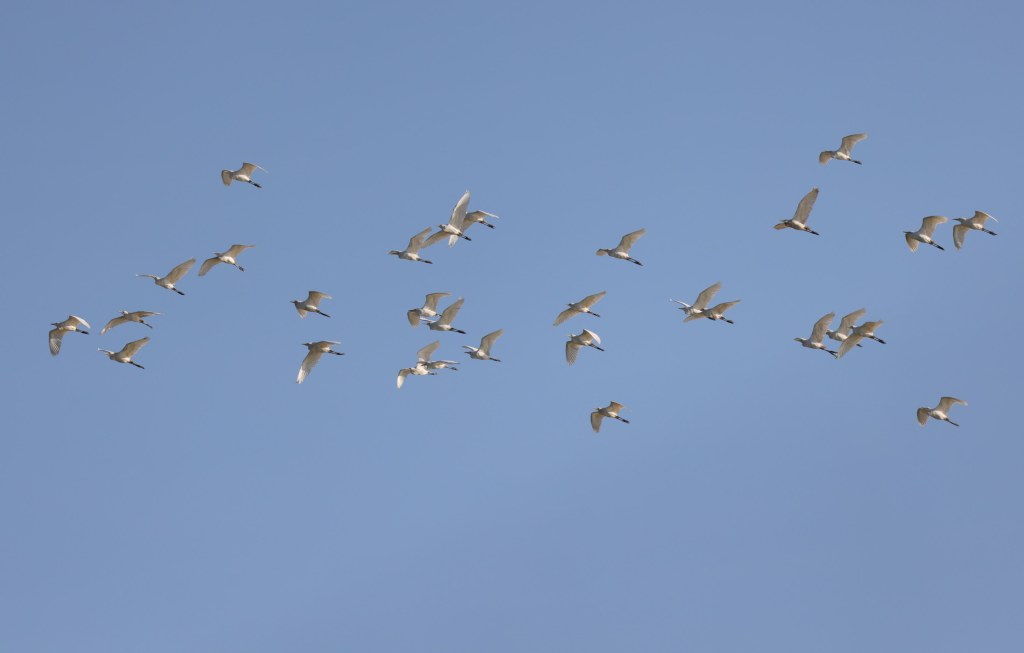

Flocks of Egrets and Pied Herons were immediately apparent, as were around twenty Black Kites and at least the same number of Torresian Crows.

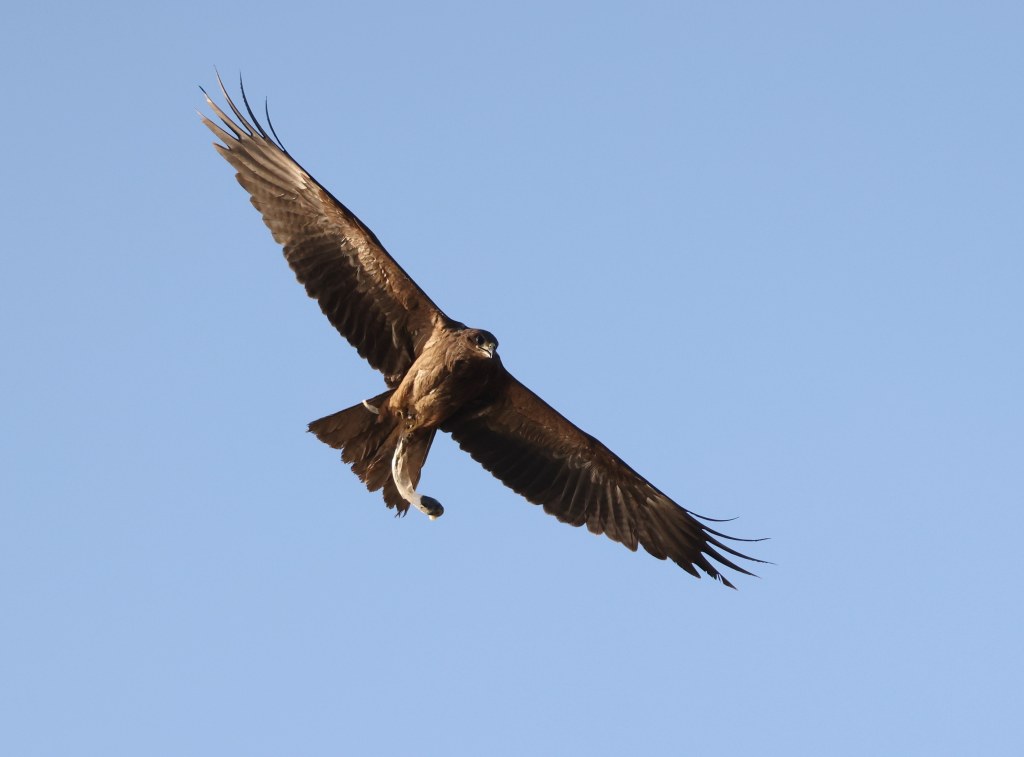
Looking through the wire fence, we saw Pied Stilts, Radjah Shelducks, Nankeen Night-Herons, Masked Lapwings, and Magpie-Larks. A single Australian Pratincole was a nice find too.
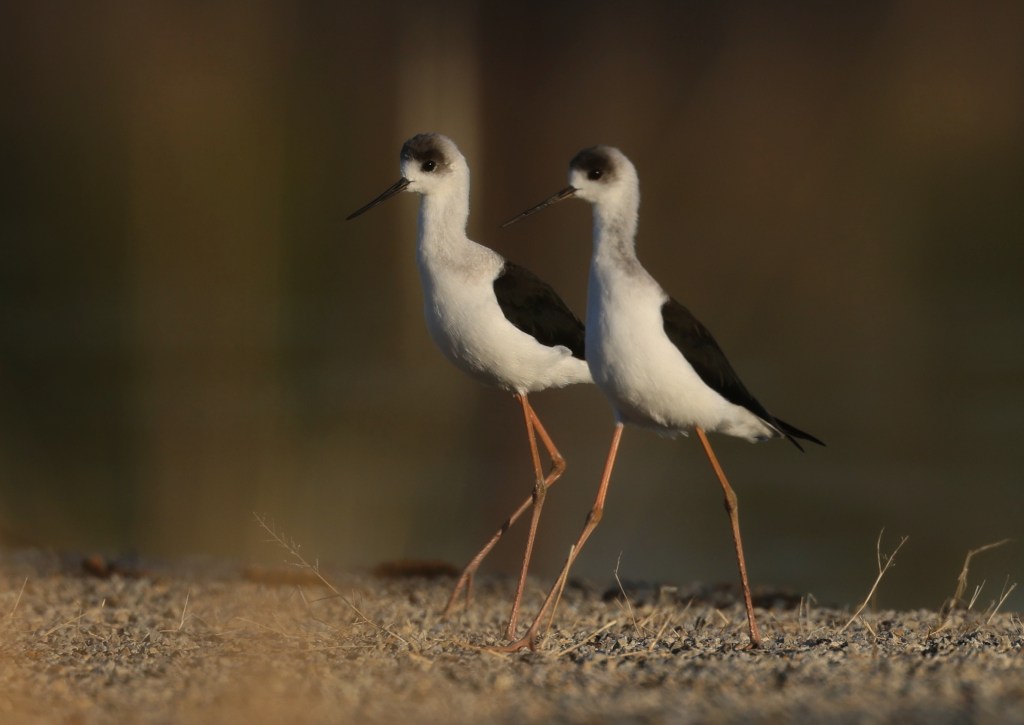
Some smaller birds like Black-Fronted Dotterels were found on scrutinising our photos later. We also saw a couple of crocs inside the facility.

Walking along the fence line we saw a Flycatcher which didn’t make it into our checklist – it was a female with extensive buffy colouring. Leaden and Paperbark are the main flycatchers found here though there are historical records of Broad-Billed and Shining on eBird.
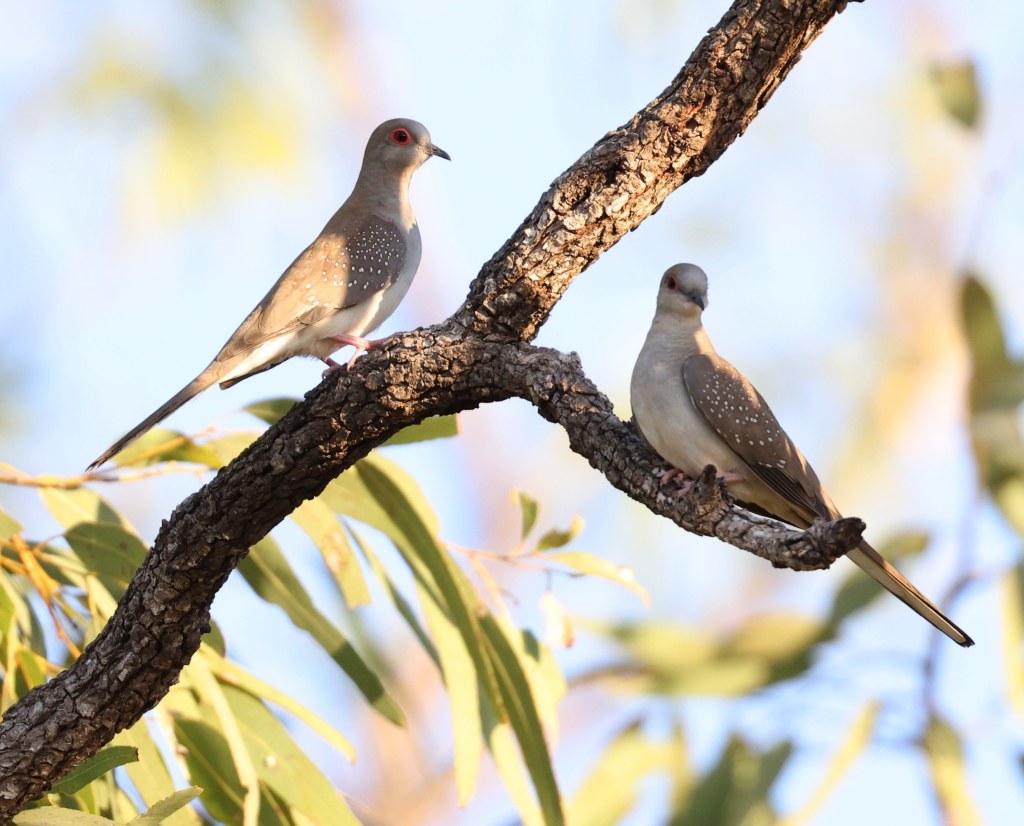
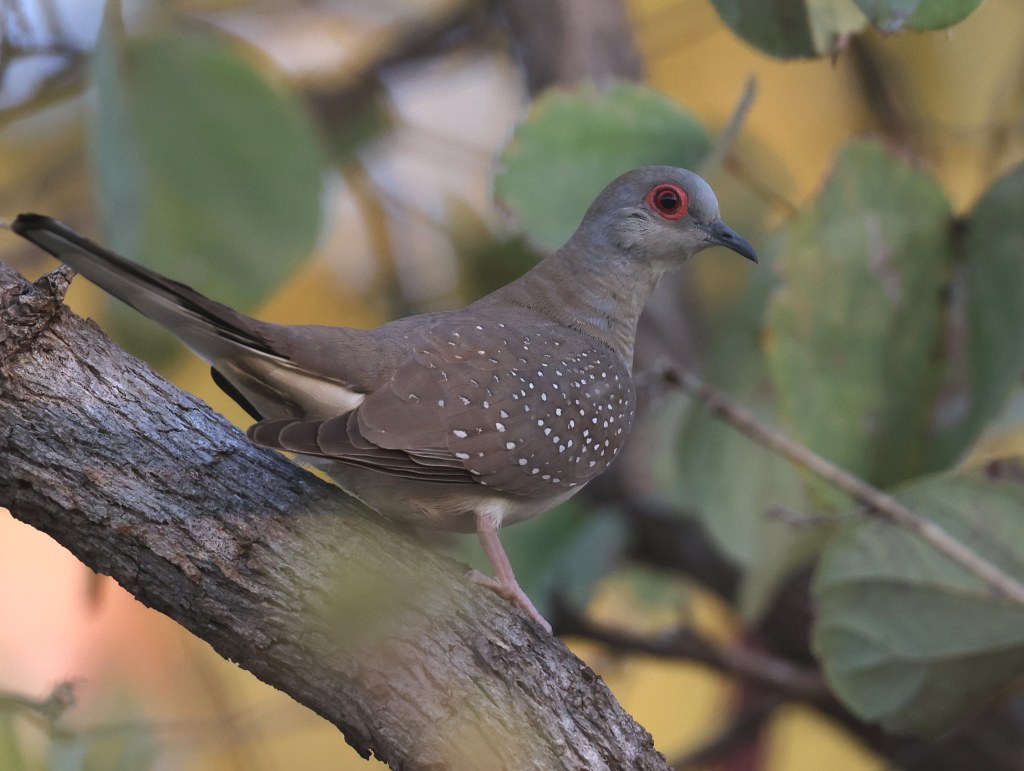
We saw several Diamond Doves (and many more Bar-Shouldered Doves) as we continued around the fence line. Then came our target birds: there around 100 Masked Woodswallows… and one White-Browed Woodswallow… and 10 White-Breasted Woodswallows. There were epic – like, seismic – numbers of small insects in huge clouds above the water, so the woodswallows would have been having a field day. As it was nearing sunset though, many of the woodswallows were resting on branches.

The dessicated corpse of a large kangaroo was a sobering sight (and smell!) before we turned back and made our way to the entrance gate, underscoring that this isn’t the most traditionally pleasant of birding locations.

We had picked up 30 species and it definitely seemed like a place where a coveted rarity could turn up, though scrutiny through the fence (ideally with a spotting scope) might be required to see it.
Summary
There are a number of interesting and worthwhile birding locations in and around Katherine, and I hope this post has given some insight into what you might expect if you are thinking about birding in the region. The Wastewater Treatment Plant is a must-visit for twitchers; the other sites in around Katherine generally have birds which can readily be found elsewhere, if you’re just looking for “ticks”. But there is some pleasant birding to be had in various locations around the town, and a great birding-scenery combo out at Nitmiluk Gorge.
eBird
Hotspots: Nitmiluk NP–Baruwei Loop (122species), Katherine Wastewater Treatment Plant (195 species), Low Level Nature Reserve (123 species)
Checklists for these visits: Nitmiluk National Park–Burawei Loop Aug 1 (33 species), Riverbank Drive Katherine Aug 1 (17 species), Low Level Nature Reserve Aug 2 (16 species), Katherine Wastewater Treatment Plant Jul 31 (30 species)
BirdSpots videos from these sites: Crimson Finches, Double-Barred Finches
Pluses and minuses:
+ Amazing scenery at Nitmiluk Gorge
+ Good selection of other spots around Katherine for birding depending on your tastes
+ The town is large enough to provide a decent base for exploring the area or breaking up a longer outback journey
+ Some unusual birds (and epic woodswallow action) at the Wastewater Treatment Plant
– Other outback sites have more illustrious reputations for birding
– Most sites can get very hot (this is the outback, after all) and some are a bit scrappy in nature
– The Wastewater Treatment Plant is closed to regular access; have to walk the fenceline and peer in
AUTHOR: ANDY GEE
BIRDERS: ANDY GEE, LUKE S, K-A
 Bird Spots
Your photos are excellent, and I appreciate the labels.
LikeLike
Love your photos and accompanying dialogue. It brings back wonderful memories of my tour of the top end exploring all of the Aboriginal sites including the famed *cave paintings etc. From East Arnhem Land to the Pilbara way back in 1970. I was there for 6 months and took over 3,000 photos. And like you, hundreds of birds and native animal life! I used a Minolta 7S camera. Which my wife in later years digitized. Since then, especially over the past 30 years I have painted many outback scenes from these photos. I am now 77. Thanks again for your wonderful contribution. *I enjoyed being given lessons in Traditional Aboriginal style of their region, using natural ochre by a wonderful Yirrkala Elder of the (Yolngu tribe) near the mining town of Nhulunbuy (where I worked). see this link:
https://en.wikipedia.org/wiki/Yirrkala
LikeLike